Archive for Player Analysis

Another Look at Arod’s 2010 Peformance Against Lefties

This post originally appeared on The Captain’s Blog and is a followup to one published at both the Yankeeist and Fangraphs’ Community Forum.

Over at the Yankeeist, Larry Koestler took a look at one of 2010’s most curious mysteries: Alex Rodriguez’ shockingly poor performance against left handed pitchers. Using pitchFX data, Koestler concludes that the pitch selection of opposing southpaws (i.e., fewer four seamers and more cutters, two seamers and sinkers) contributed to Arod’s struggles (while also conceding the limited sample size), but could the answer be much more benign?

Read the rest of this entry »


A PitchFX Look at A-Rod’s Bizarre Reverse Platoon Split

This post originally appeared on Yankeeist.

It’s no secret that Alex Rodriguez produced the lowest full-season wOBA of his career in 2010 — his .363 mark was fueled by career-lows in batting average (.270), on-base percentage (.341) and the second-lowest full-season SLG of his career (.506). That these numbers were not only dramatically off from his superb 2009 (.286/.402/.532; .405 wOBA) but his majestic career triple slash (.303/.387/.571) suggests to me that he should be due for a reasonable bounceback. While it’s not impossible Alex has reached an irreversible decline, he’s been too historically good for me to be willing to write him off just yet. I won’t go so far as to proclaim that the Yankees are going to be getting .400-plus-wOBA A-Rod back, but as I’ve noted on at least one occasion this offseason, all A-Rod needs to do is exercise just a tad more patience and a wOBA in the .380s should be more than doable.

Read the rest of this entry »


Why I Can’t Ignore Stats

If some of you have been active in following your Hall of Fame voters, you probably read this post on Jon Heyman discussing his ballot. He spent the majority of this piece stating why he didn’t vote for Bert Blyleven, and then he explained why he voted for Jack Morris instead. I promise this is not intended to be a “Vote Blyleven, not Morris!” post, because I’m more interested in something else. Heyman claims that Morris had a bigger impact in his games than Blyleven. Well then, what happens if I never experienced this impact?

Read the rest of this entry »


Gallardo Must Throw More Strikes

Of 132 starting pitchers that have thrown at least 100 innings this season, Brewers’ right-hander Yovani Gallardo has the third lowest O-Swing% in the majors at 24.8%.  That means opposing hitters swing at 24.8% of his pitches that are outside the strike zone.

Even Nick Blackburn and Brian Bannister get more swings at pitches outside the zone.

Common sense suggests the better a pitcher’s repertoire, the more hitters will chase bad pitches.  Therefore, we would expect Yovani Gallardo to have below-average stuff and a lower strikeout rate because he gets fewer hitters to chase bad pitches.

That is, we would expect that to be the case if we merely looked at Gallardo’s O-Swing% in a vacuum.

As it turns out, Gallardo gets very few hitters to swing at pitches outside the zone because hitters rarely swing in general with Gallardo on the mound.  His 40.8% swing rate is the fourth lowest in the majors (min. 100 innings).  Not only that, but hitters also do not make contact often with his pitches when they do swing – as evidenced by his 79.6% contact percentage and 8.3% swinging-strike percentage.

We can infer from these numbers that hitters flat-out do not see Gallardo’s pitches very well from the mound.  Hitters do not swing often – and when they do, they do not make much contact.

In short, Gallardo has well above-average stuff.  His 92-94 MPH fastball is a plus-pitch, and his spike curve can be deadly when he is not spiking it before it reaches the plate.  Moreover, Gallardo has developed a slider, which is arguably becoming his best pitch.

So, how can Yovani Gallardo transform himself from a top-tier #2 pitcher to a full-fledged ace?

The answer appears to be simple.  Throw more strikes.

Of the starting pitchers that have thrown at least 100 innings in 2010, Yovani Gallardo throws the 7th fewest balls in the strike zone. (Livan Hernandez is predictably number one).  That high-percentage of balls outside the strike zone would be acceptable, but as we have established earlier, Gallardo does not induce many swings outside the zone.

That obviously leads to higher walk rates, higher pitch counts, and lower innings totals.  Those are all things that must change for Yovani to be a true ace in Major League Baseball.

Many of you are likely thinking: “Of course Gallardo should throw more strikes. That is an obvious statement.”

Not necessarily.

Some pitchers, such as Livan Hernandez and Jamie Moyer, live on throwing balls outside the strike zone.  They do not have good enough “stuff” to live by throwing strikes.  They have contact percentages north of 92% on balls inside the zone, so they bait hitters and get them to swing at poor pitches.  Both of them have literally made a career avoiding the strike zone

Gallardo is not that type of pitcher.  It seems opposing hitters have decided their best chance to reach base is to actually not swing at all, merely hoping the upcoming pitch is a ball – which it is 57.4% of the time.  That accounts for the high pitch counts, the low walk totals, and the low inning totals.

The only worry about Gallardo throwing more strikes is that more balls would then be put in play, which may not be a positive outcome with Milwaukee’s below-average defense.  It could effectively be argued that Gallardo is better suited to stick to walks and strikeouts – though the Brewers’ front office should work to solidify the defense this winter.

Throwing more strikes would lower the pitch counts, lower the walk rates, and increase the number of innings pitched without sacrificing production on the mound.  Opposing hitters do not make much contact whether or not Gallardo throws the ball in the strike zone, so he may as well cut the walk rate and work in the strike zone much more often.

His development of a slider should aid that mission.  That spike curveball cannot be thrown consistently for strikes, but his new slider (sometimes cutter) can be thrown for a strike on any count.

Perhaps that is the missing piece that can help Yovani Gallardo transform himself into a bona fide ace for the Brewers.  Or perhaps the right-hander simply needs to make a conscious effort to not nibble.

Whatever the case may be, everyone certainly knows the Brewers organization could certainly use an ace.  Milwaukee’s success in 2011 may hinge on whether or not Gallardo is able to take the next step in his development – which seems to be consistently throwing more strikes in every start.


Wainwright Throws Fewer Fastballs, Increases Effectiveness

Adam Wainwright’s strikeout rates keep increasing. In over 400 innings in AA and AAA during his age 21-23 seasons, his strikeout rate was 7.8 per nine innings. When he was elevated to the majors in 2006 as a relief pitcher his strikeout rate took an expected jump to 8.64 K/9. At the time he was throwing his curveball 25.9% of his pitches. A return to starting the following year led to a decrease in both his curveball use (18.6% in 2007 and 17.9% in 2008) and his strikeout rate (6.06 K/9 in 2007 and 6.20 K/9 in 2008).

In 2009, Wainwright made a change in his pitch selection, reverting back to the curveball percentages from his bullpen tenure. The increase in curveball use (24.0% in 2009) increased his strikeouts per nine to 8.19 and turned him from an above-average pitcher (3.90 and 3.78 FIP in 2007 and 2008, respectively) to a Cy Young contender (3.11 FIP). The increased use of the curveball in 2009 also increased its effectiveness, doubling to 2.71 wCB/C. The effectiveness on his slider tripled. Unfortunately, his fastball decreased in effectiveness, going from essentially average to -.75 wFB/C.

In 2010, Wainwright has taken his curveball use to another level, increasing to 28.5% of his pitches and his strikeout rate to 8.26 K/9 and lowering his FIP to 2.86. He has not sacrificed control, lowering his walk rate to 2.21 BB/9. His curveball and slider, which may be more of a cutter, have been slightly less effective, but still very useful pitches. The significant change has occurred in the effectiveness of his fastball. Wainwright has decreased the number of fastballs thrown to a career low 46.5% of pitches. With this decrease has come a drastic increase in the effectiveness of the fastball without changing the velocity, moving to 1.00 wFB/C from last year’s total of -0.75 wFB/C.

Also of note, increasing his strikeouts has not affected his efficiency, with 15.7 P/IP in 2007, 14.8 P/IP in 2008, 15.5 P/IP in 2009 and a career low 14.6 P/IP in 2010.

Wainwright has remained effective this season throwing the third highest percentage of curveballs of any pitcher. (Only Wandy Rodriguez and Gio Gonzalez have thrown a greater percentage of curveballs this year.) When you have the curve he has, you can’t blame him. The consequence, whether inteneded or not, is a sea change in the effectiveness of his fastball.  Another Cy Young-caliber season at a bargain price for the Cardinals.


Another Look at Mauer’s Power

Again looking at leaderboards, I noticed that only one of the top 10 hitters by batting average has fewer than 10 home runs; that would be your 2009 American League MVP, Joe Mauer.

Mauer is hitting .324 through 127 games and, barring a disaster to end the season, will finish as a 5-WAR player.  It’s a far cry from his 8-win 2009 season (which no one could reasonably expect him to repeat), and just looking at his lines across the two seasons, it’s not hard to see where the difference is.

Read the rest of this entry »


2010 Pitchf/x Summit Recap

A few weeks ago, Sportvision hosted the 3rd Annual Pitchf/x Summit.  Sportvision is the company behind the Pitchf/x system and has initiated Fieldf/x, which I’ll get into in a minute.  The goal of the summit was to share some of the research being done in baseball analysis, while also serving to explain the possibilities that exist with the new system.  Without further ado, here were the presentations:

Using Velocity Components to Evaluate Pitch Effectiveness (Matt Lentzner/Mike Fast): The purpose of this study was to change the reference point by which Pitchf/x data are measured.  Often, fastballs show more movement than breaking balls, but without the proper frame of reference, it means nothing.  Mike and Matt were able to demonstrate how to determine the horizontal and vertical velocities with respect to the batter’s eye and make the Pitchf/x data more meaningful.

Pitchf/x Application in Player Development and Evaluation (Dr. Glenn “Butch” Schoenhals): Dr. Schoenhals has a Pitchf/x system set up at his instructional school, which allows pupils (including some major leaguers) to see the their pitches broken down immediately and make adjustments.  In conjunction with three cameras set up around the pitcher, the Pitchf/x data provide benefit to both pitchers and instructors in learning/teaching how to pitch.

Okajima’s Mystery Pitch (Matt Lentzner): Hideki Okajima throws a pitch roughly 20% of the time that had previously been classified as a curveball, more specifically a “rainbow curveball.”  Actually, it didn’t really fit any of the known pitch types.  Using his research on pitch types and arm slots (“The Pitching Peanut”), we see that this pitch has almost no break, is faster than a curveball but slower than a slider, and falls at the exact center of the peanut.  His explanation: Okajima is the Boston pitcher who is actually throwing the gyroball, not his more famous teammate Daisuke Matsuzaka.

Leaving the No-Spin Zone (Alan Nathan): Dr. Nathan showed his experiments that relate the spin of the baseball just before and just after it is hit. The result? The two are almost totally independent of each other! I couldn’t believe that, but Dr. Nathan made a lot of sense.  This was a high-grade physics lesson, crashed into about 20 minutes.  He explained why balls tend to curve toward the foul lines; he showed that the bat actually “grips” the ball for a few nanoseconds or so before the ball explodes off the bat, which contrasts the earlier model of the ball “rolling” off the bat.  Really, really cool.

Fieldf/x System Overview (Vidya Elangovan): And the main event began.  Fieldf/x is a new tracking system that utilizes cameras attached to the light standards in baseball stadiums (for now, just AT&T Park) to track the movement of every person on the field 15 TIMES A SECOND.  As soon as I heard that, my mind started going crazy and I don’t think I paid attention for about 5 minutes.  The only issue at the time is that the system does not include the ball (but it will).  All ball events currently have to be added by someone watching the video.  The following presentations showed some of the things you can actually do with the data, and it’s fairly obvious that these data, particularly when connected to batted ball data through the Hitf/x database, are about to revolutionize how baseball players are evaluated.

Infield Defense with Fieldf/x (John Walsh): Actually the first presentation, thanks to being in Italy, (tough life), but it really would have been more helpful after the overview.  Either way, a lot of cool stuff.  First thing he said was that in tracking the different players, he noticed that an average centerfielder runs 8 miles per game, which stunned me and kept my attention.  Thanks to these new data, we can also see the effects of shifts and also what players away from the ball are doing while teammates are attempting to make plays.  Other questions John poses: can we see infielders cheating in a certain direction as the pitchers throws the ball? Do infielders lean in a certain direction before the pitch? Based on his initial investigations, he saw that third basemen step toward the line as the pitch is delivered and shortstops step directly at home plate.  Weird, but potentially important, and just a peak into what can be obtained.

From Raw Data to Analytical Database (Peter Jensen): As a baseball nerd and a programming dork, this was really cool.  Peter Jensen took the 400,000 lines of code that results from each game and wrote a macro to display what actually happened in the game in an Excel worksheet.  The simulation relates the position of each player as well as an approximation of where the ball is throughout the play.  His solution with regards to the reorganization of the data was very impressive for a first run, and it is absolutely vital to make the data useful for analysis.

Using Fieldf/x to Assess Fielders’ Routes to Fly Balls (Dave Allen): These next three were absolutely incredible to me (and I’m sure the last three would have joined them had I had the time to stay).  By using the data to reconstruct fielders’ routes to the ball, Allen surmises that the Fieldf/x data can be used to determine the speed of an outfielder as they pursue a ball, the starting points of each fielder at the time of the pitch (and hit), and how efficient each player is in getting to the ball (measuring the distance traveled against the shortest distance to the ball).  To me, this is something that teams can use to help players they already have by addressing alignment issues or noticing what is happening during the different points of pursuit.  Are outfielders getting good reads/jumps on the ball?  Are they running in straight lines or weaving?  Simply put, the data can confirm for us (and also measure exactly and more efficiently) what our eyes (and scouts’ eyes) have seen.

Measuring Base Running with Fieldf/x (Mike Fast): Mike’s presentation examined the different portions of base running and what the data can be used for.  Mike was able to track each base runner’s path around the bases, even what they were doing on pitches that weren’t hit (during which we would typically say “nothing happened”).  Obviously, with all of these data, there’s a lot happening.  Also, by knowing the position of the player at each moment in time, we can track both his speed and acceleration as rounds the bases; very valuable information for measuring “baseball speed.”

Fieldf/x of Probabilities: Converting Time and Distance into Outs (Jeremy Greenhouse): The coolest of the presentations.  As soon as he said the words “probability model,” I was sold.  Jeremy first examined stolen base attempts (in the thirteen games of data released, he only found four) and tried to determine the different component times of the stolen base attempt.  Some things he brought up that were interesting: “Pop” times, or the time it takes a catcher to catch the ball and get it to second base, was between 2.0 and 2.2 seconds for all attempts, which suggests that a lot of stolen bases are taken off pitchers, not catchers.  The ability to get a good lead is now measurable, as well as the jump a runner gets on the pitcher.

Jeremy also developed a model to determine the probability that a player makes a play on a ball hit near him.  The model was based on where the player is, where the ball would come down, and how long it would take the ball to get there.  From there, the player’s probability can change based on his jump, route, speed, and what I called “catching ability,” or the ability to actually make a play on the ball when in the vicinity.  It was shocking to see some of the plays made where players started out with low (less than 10 percent) chances of catching the ball, but by getting a good jump and running (quickly) in a straight line toward the ball, their probability would increase each 1/15 of a second.  He then showed the video of these plays and we were able to see the spectacular catches made by really good outfielders.  This also applies to outfielders who start with a low probability to make the catch, but increase it as they, for example, chase a ball into the gap, close quickly on it, but don’t catch it.  The ability to increase the probability of a catch is very valuable and that knowledge would be immensely valuable to teams.  Lastly, he also showed how bad outfielders can turn outs into hits by reading the ball poorly, getting bad jumps, and being indecisive.  Super cool, and as soon as the presentations are made available online (which hopefully will be soon), I will link to some of them, but especially some of these graphs.

Unfortunately, I missed the following presentations, so I will just show the abstracts presented in the program.

Where Fielders Field: Spatial and Time Considerations (Matt Thomas): Continued application of close-range photogrammetry through high-resolution digital photography to baseball is revealing hitherto unseen patterns of fielding in the game. Matt examines these patterns and where data permit, factors time into this examination. After reviewing general trends he notes specific achievements and then speculates on whether any of this freshly quantified insight tells us what makes for good (and not so good) fielding.

Scoutf/x (Max Marchi): This presentation evaluates players’ tools with Pitchf/x, Hitf/x, and Fieldf/x.

True Defensive Range (TDR): Getting out of the Zone (Greg Rybarczyk): Greg intends to display detailed tracking of the 25 batted balls in the released data that were hit in the air to the outfield. Presented data will include the relative positions of the outfielders and the ball from the time the ball leaves the bat until the time it is retrieved by the fielder. Using the essential elements of this data (fielder starting position, ball hang time and landing point), he outlines the fundamentals of a new outfield defensive metric, called ‘True Defensive Range’ or TDR, which should provide more accurate player defensive ratings with a smaller required sample size than current metrics. Full realization of this metric will require establishment of baseline values using the full data set. TDR for infielders will employ a similar method, but it will not be covered during this presentation.

The Future of Sportvision’s Data Collection (Greg Moore): Greg will talk about several bits of baseball data that Sportvision might collect in the future, and he will discuss how the data can be used in conjunction with Pitchf/x, Hitf/x, and Fieldf/x. Greg will also conclude the 2010 Pitchf/x Summit with closing remarks.

Obviously, there was a lot of cool stuff presented.  As mentioned, only 13 games worth of data were released to the analysts and most of the presentations were about determining what could be done with the data.  But with enough work and research, it will not only change the way teams and analysts evaluate players, but also will give teams another tool with which to teach their players and improve the guys they already have on the roster.  We’ll also know exactly what skills are important in each aspect of the game (base running, fielding, etc.), and as we learn these things we’ll discover other things we want to know.  I’d love to know what you guys think of all this and I’ll try to answer any questions you have about what can and can’t be measured and how we’ll use it in the future.

UPDATE: After I wrote this mess, I discovered this, much cleaner, detailed, mess, written by Baseball Prospectus writer Ben Lindbergh.  I’ll link to it down here because I want you to read what I wrote instead of Ben’s running diary.  Sorry, Ben.

This article was originally published at Knuckleballs, written by Dan Hennessey.


Matt Kemp’s Struggles: Fastballs

Matt Kemp has been struggling this season, and even if you account for the low BABIP (.303) compared to his xBABIP (.335), he is still striking out at a higher rate this season (28.1%) compared to last (22.9%). What has also confounded me is thatm even though he has a higher strikeout rate, he is also setting a career high in walk rate as well (8.1%). Usually, drawing walks and getting struck out are thought of as tradeoffs, opposite ends of the “patience scale.” Last season, Kemp hit .362/.429/.616 against LHP and .278/.329/.453 against RHP, but this season, he is down to .303/.341/.443 against LHP and .240/.306/.445 against RHP. What happened?

There are two questions I’d like to investigate: 1) Is Kemp swinging at more strikes in 2010 compared to 2009 and how? and 2) Is Kemp making less contact in 2010 compared to 2009 and how?

To answer these two questions, I’d like to look at Kemp’s swinging strike percentages (swinging strikes per pitch) and contact percentages (contact made per pitch) against all fastballs (four-seamers, two-seamers, cutters, and splitters). Checking to see any differences between 2009 and 2010 should lend some insight into Kemp’s offensive struggles this season.

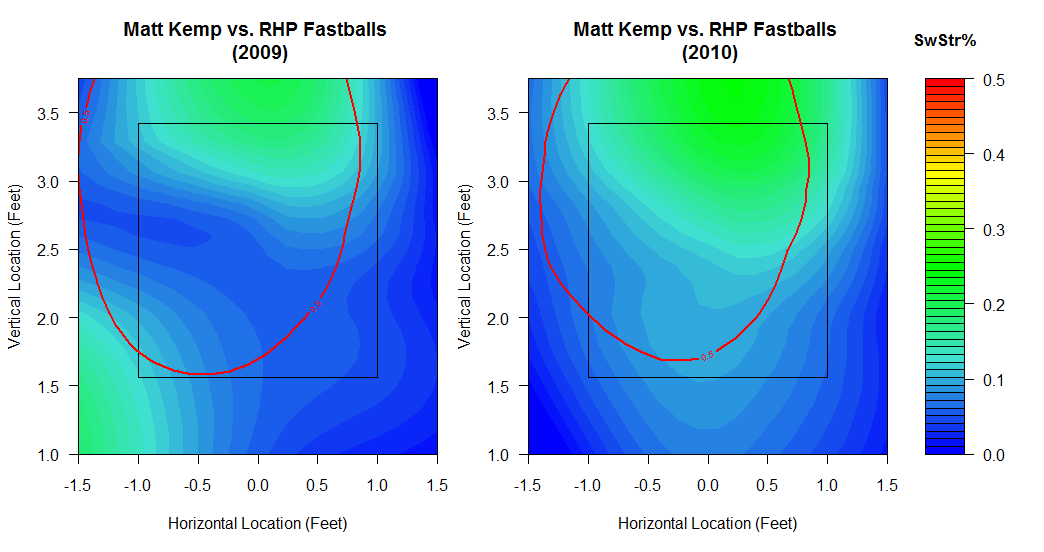
I ran several regressions to model surfaces of Kemp’s swinging strike percentages and contact percentages as well as his swing zones. First up, let’s take a look at Matt Kemp’s SwStr% against RHP fastballs:

The red contour lines tell us that Kemp chooses to swing 50% of the time when a ball is thrown within the contour line. This is what I call Kemp’s swing zone, so the red circles refer to this. Further examples and explanations of these swing zones can be seen here. What the swing zones tell us here is that Kemp is swinging less at RHP fastballs in 2010, but is whiffing at a much higher rate as well. He is also missing more RHP fastballs down the middle as compared to before.

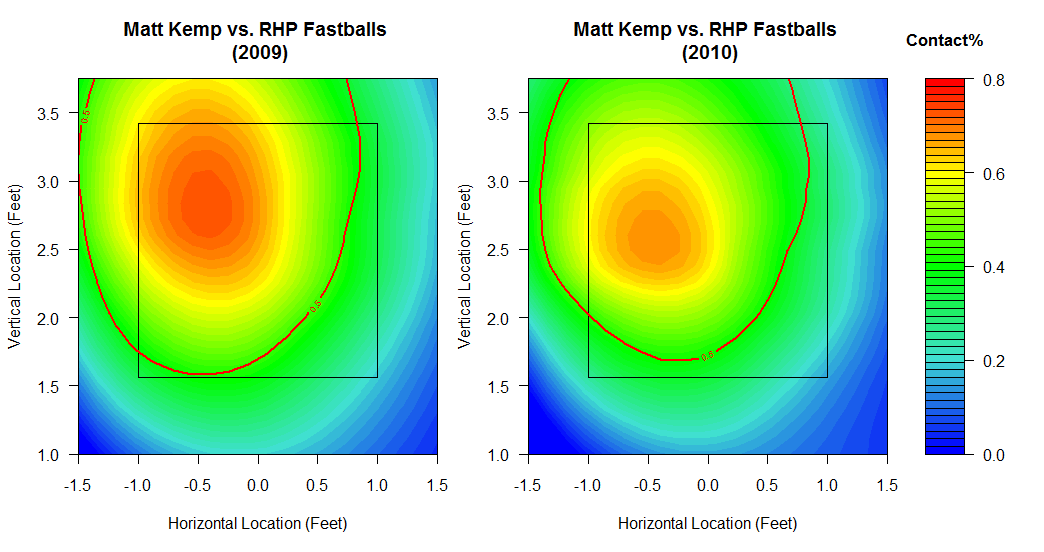
Let’s check Kemp’s Contact% against RHP fastballs to see if his swinging strikes are affecting his ability to make contact:

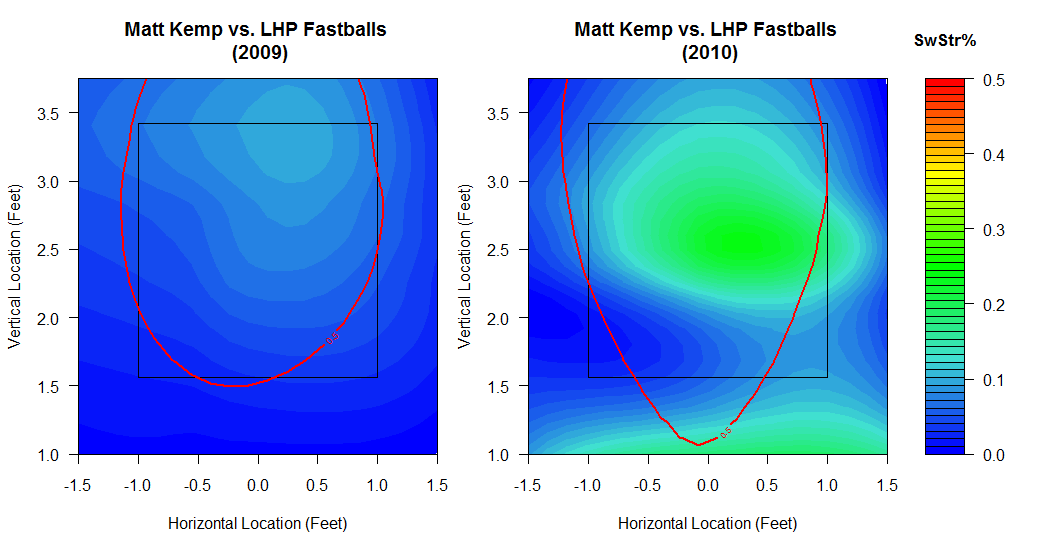
The red contour lines are the same as in the previous two graphs. Clearly, Kemp is making a lot less contact off RHP fastballs, and this tells me that he is putting the ball into play less. The previous two show Kemp swinging and missing more, while these two show Kemp making less contact, particularly on high inside fastballs. Let’s take a look at how Kemp has been doing against LHP fastballs, first at his SwStr%:

Here are his swinging strike plots, Kemp has actually started to swing more on LHP fastballs down and out of the zone (the red contour lines dip in 2010), so his swinging strike rate there is up. But he is also missing a lot more LHP fastballs this year that come down the middle over the plate, ideal pitches for the right-hander to hit out of the park. This is particularly concerning when you consider that Kemp’s wFB/C (runs above average per 100 fastballs) was at 1.64 last season, while that number is down to 0.38 this season. A major part of that drop must have to do with Kemp whiffing on fastballs down the middle that he used to hit.

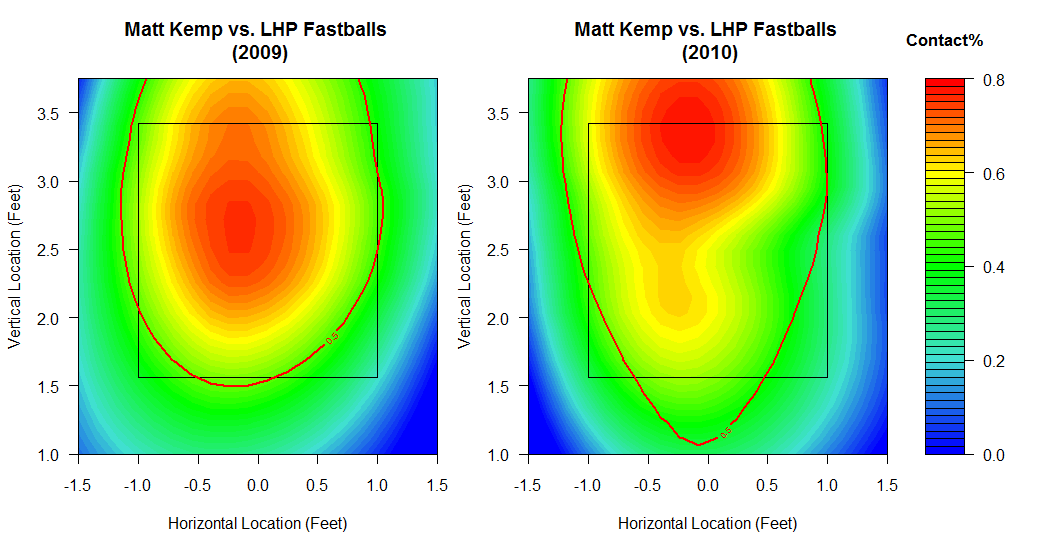
Finally, let’s look at Kemp’s Contact% against LHP fastballs:

Looking at his contact plots, we see similar colors in where he makes the most contact (making contact 80% of pitches in those areas). But we notice a huge shift in where the epicenter of that hotspot is. Last year, Kemp made contact off a lot of LHP fastballs down the middle of the plate, but this year, the epicenter of that contact hotspot has shifted a full foot up from the direct middle of the zone to the top of the zone. We can infer that Kemp is making less contact off the sweet spot of his bat, and making more high fastball contact that usually result in pop outs. This is problematic and adds further evidence that Kemp is simply missing fastballs down the middle as well as chasing high fastballs.

In general, what I present here is what Dodgers’ fans already know: Kemp is swinging and missing a lot. But I hope that I was able to demonstrate clearly how Kemp has been struggling against fastballs, showing where he is whiffing on them and where he is making less contact.

An article over at Memories Of Kevin Malone convinced me that perhaps Kemp’s whiffing behavior this season (along with swinging less and drawing more walks) could have been caused by Kemp’s change in swinging mechanics. Finally, if you visit my blog at Think Blue Crew, you can read a longer post about Kemp’s offensive struggles against breaking balls as well.

A variation of this article was originally posted at Think Blue Crew, a blog dedicated to data visualization of baseball, basketball, and football statistics. Check it out for more f/x visualizations like this.


Mark Reynolds’ Whiffs by Pitch Type

Mark Reynolds is perhaps one of the more interesting power hitters heading into his prime this season. He has led the entire league in strikeouts since 2008, holding the all-time record for most strikeouts in a season with 223 K’s last season.

This year, he leads the league once again in strikeouts, as well as perennial leader in swinging strike percentage. He has whiffed on 17.3% of all pitches this season, second place being Ryan Howard at 14.4%. Interestingly, Reynolds does not actually swing at everything a la Jeff Francoeur (60.7% swing percentage) and is barely in the top 50 in percentage of pitches he swings at with 46.8%. This makes it even more amazing that Reynolds leads the league in strikeouts and swinging strike percentage regularly without even taking that many swings. That’s a lot of whiffing going on, and I do suppose that the rare times he does connect the bat to the ball, he hits it hard.

I wanted to know more about Mark Reynolds’ swinging strike percentages to see how he fares against certain pitch types by handedness. Of the five main pitch types, fastballs, sliders, cutters, curveballs, and changeups, Mark Reynolds has seen cutters less than 200 times since his debut, 139 cutters from right-handed pitchers and 41 cutters from left-handed pitchers. He has seen at least 200 pitches for the other pitch types for right-handed pitchers or left-handed pitchers. Ignoring cutters due to small sample size, I will take a look at Reynolds’ swinging strike percentages against four-seam fastballs, sliders, curveballs, and changeups.

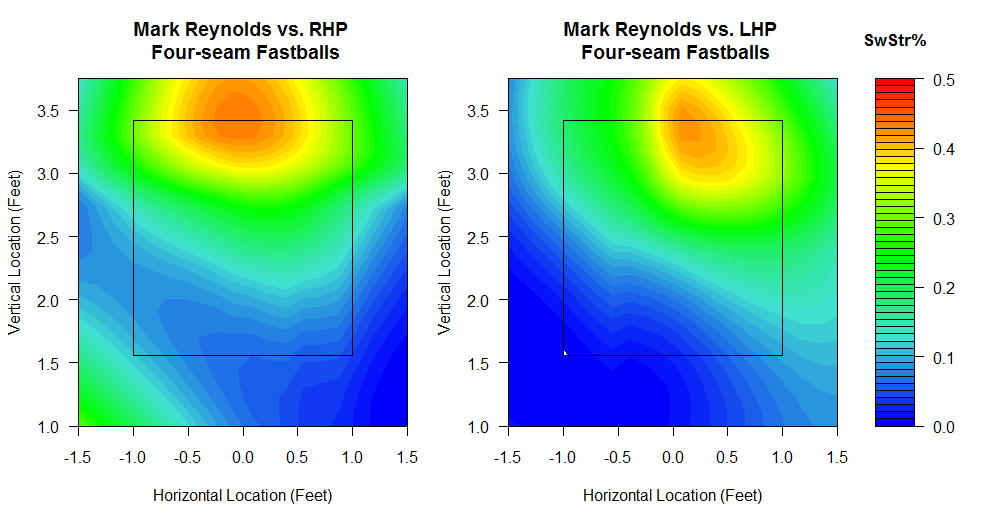
Let’s take a look at Mark Reynolds’ swinging strike percentages against four-seam fastballs split by RHP and LHP (1435 pitches from RHP, 468 pitches from LHP):

Four-seam fastballs

Here, it looks like Reynolds falls victim to high fastballs from both right-handers and left-handers. For Reynolds, he whiffs on the outside fastball from LHP stick out as well as the low and inside fastball from RHP.

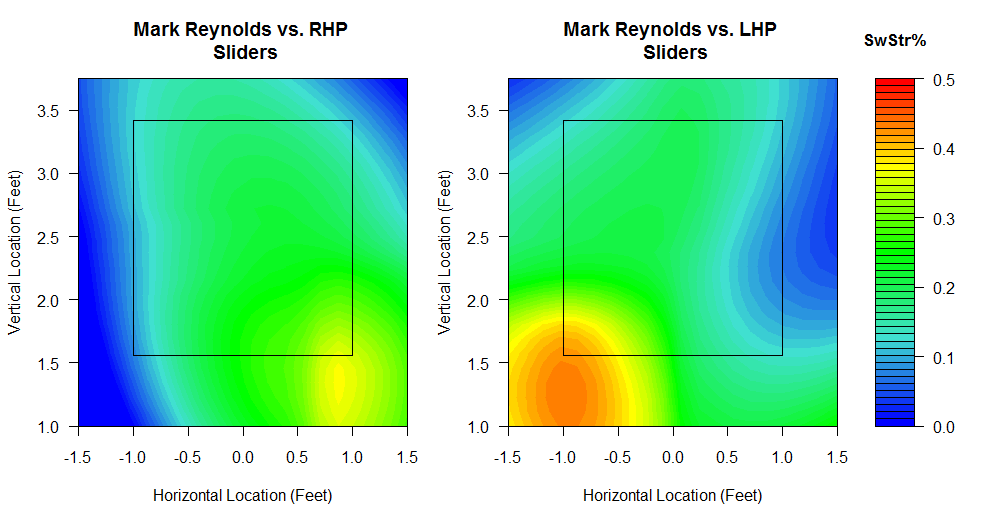
Here’s a look at Reynolds against sliders (1542 from RHP, 224 from LHP):

Sliders

This is interesting. Reynolds strikes out far more against right-handed pitchers than against left-handed pitchers, but he tends to swing at (and miss) sliders coming from LHP more than he does from RHP. LHP sliders come low and inside while RHP sliders go low and outside, but even LHP sliders coming in from low and outside are swung at and missed by Reynolds.

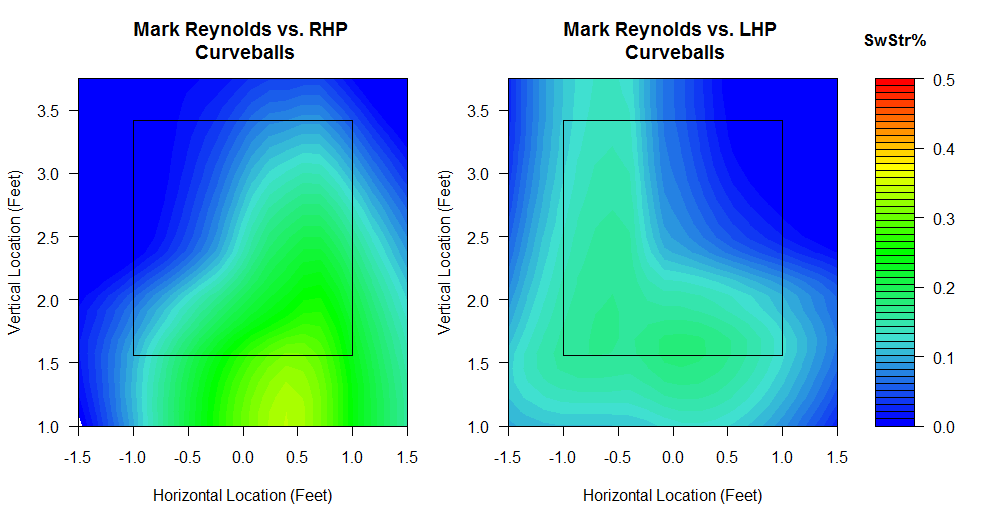
Curveballs against Reynolds are a whole different story (567 from RHP, 228 from LHP):

Curveballs

Here, Reynolds clearly struggles at connecting on curveballs from right-handed pitchers, some in the strikezone and most low and outside the strikezone. Curveballs from LHP also get Reynolds to whiff sometimes on the inside part of the plate as well as the lower part.

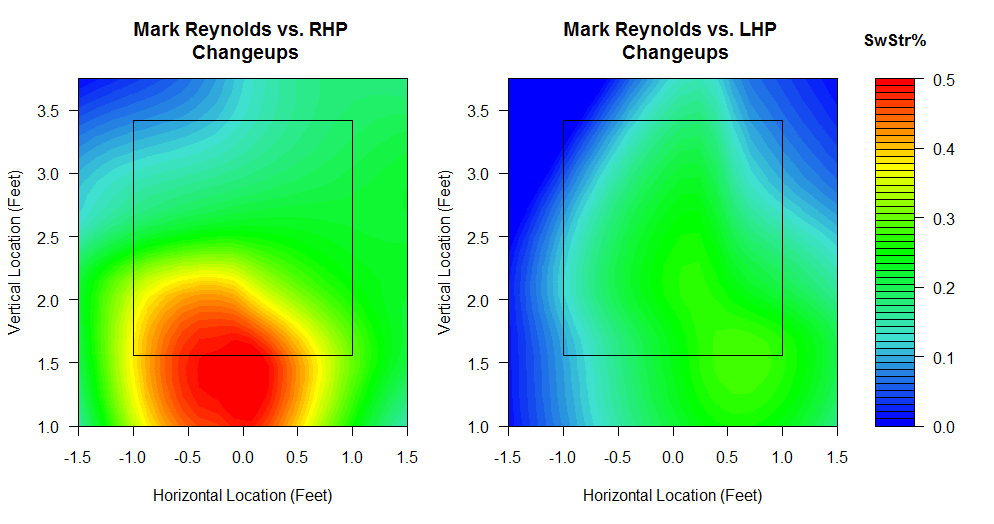
Finally, here’s a look at Reynolds against changeups, which look like his greatest weakness when it comes to missing pitches (430 from RHP, 338 from LHP):

Changeups

This is very telling. The splits against changeups are very different, as Reynolds whiffs on over 50% of changeups from right-handers that are located on the edge of the strikezone at the bottom. This is much different from LHP changeups, where any spot doesn’t look to cross over 30% whiff rate, except the lower righthand corner of the zone. What’s also crazy about this is that when you look at Reynolds against changeups in general, he misses at around 20% of nearly all changeups low outside and nearly all areas within the strikezone as well.

From these plots, there are characteristics of Reynolds’ swinging strikes that are similar to conventional thought and common knowledge, such as chasing high fastballs or low breaking balls. But the key to exploiting Reynolds’ weakness at missing the ball when swinging is definitely throwing timely changeups, especially from right-handed pitchers, while it seems that Reynolds is less prone to whiff against LHP curveballs the most.

This article was originally posted at Think Blue Crew, a blog dedicated to data visualization of baseball, basketball, and football statistics. Check it out for more f/x visualizations like this.


Cesar Izturis’ Inexplicable Continued Employment

As far as value goes, being a +5.8 WAR player is generally considered quite an accomplishment. After all, only three players have accrued that much value this season (Josh Hamilton, Cliff Lee, and Roy Halladay) and the list of those who topped the mark last year is a roll call of stars.

Why, then, is it with a contemptuous sneer that I note that Cesar Izturis is a +5.8 WAR player? Because that’s his career mark. As shocking (or not, if you happen to be an Orioles fan) as this may be, four months of 2010 Josh Hamilton has been more valuable than an entire decade of Cesar Izturis.

And because direct numerical comparisons are always an exhilarating exercise, why don’t we look at the career WAR marks of some other shortstops? Luminaries who have surpassed the “Izturis Line” include Bobby Crosby (in 1,342 fewer plate appearances), Alexei Ramirez (in a whopping 2,637 fewer PA), the significantly-less-than-immortal Damian Jackson (in 1,676 fewer PA), and Pokey Reese (in 1,047 fewer PA). These are but a few members of the list of unspectacular shortstops who were more valuable in fewer plate appearances than Cesar.

In light of this staggering performance, I think the two main points to investigate are why he has been so awful (given his rep as a serviceable option) and what has compelled MLB teams to run him out there on a daily basis since just after George W. Bush took office the first time.

Considering that during every one of my visits to Camden Yards this year I’ve played a mental game of “Is Cesar’s ISO above or below 0.040?” (it currently sits at a tied-for-MLB-worst 0.038), it seems like his prodigious lack of power is a good place to start. Despite posting a very reasonable strikeout rate (9.7%), an OK walk rate (4.9%), and a mediocre but not crippling BABIP (.281) in his career, Izturis boasts a meager .276 lifetime wOBA, a direct result of an equally abysmal .068 career ISO. Never in a full season has he produced an ISO above .100, although he did give the Blue Jays a (comparatively) robust .119 ISO in 46 games in his rookie year in 2001. All of this ineptitude translates to an insane -169.9 batting runs over 4,185 PA spanning the past decade.

But, you argue, he’s not known for his bat. It isn’t fair, hypothetical you argues, to judge him without looking at the superior defense he provides. This segues nicely into my second question, which is why MLB teams continue to pay him to play every day.

As nearly as I can tell, Izturis’ rep among baseball media and traditional fans is that he’s a superb fielder and a decent overall player. After all, you can certainly do worse than a Gold Glove winner at short, right? Unfortunately for anyone who espouses this belief (I’m looking at you, Gary Thorne and Jim Palmer), it just isn’t true.

No matter how much you want to complain about UZR or DRS as defensive metrics, I’m willing to believe that over the course of 8,300+ career innings they paint a fairly accurate picture of Izturis’ true talent level defensively. UZR has him at +6.7 per 150 games at SS (+45.6 runs total among all positions) while DRS has him at 48 career runs saved, so the metrics agree. At that +6-8 runs per season level, Cesar has been above-average but certainly not elite with the glove.

Is this a case of MLB teams overvaluing defensive contributions at the expense of offense? After all, even the two-year, $5 million deal the Orioles gave him prior to the ’09 season has been more than the Venezuelan has been worth (+0.8 WAR during his time with the O’s). Perhaps teams let their scouting departments and Izturis’ hardware (’04 Gold Glove winner) cloud their judgment, or perhaps there just aren’t any other near-replacement-level shortstops out there. Although I’m skeptical about that last possibility.

And yet, for a guy who has hit 15 career home runs (or as many as Jose Bautista has hit since Independence Day), topped the +0.2 WAR mark just thrice in his career, and averaged a paltry +0.4 WAR since 2004, Izturis is certainly doing pretty well for himself. After all, he gets to start every day for a major league team.

Nathan Biemiller is a junior at Franklin and Marshall College who writes regularly for nothing but his college newspaper. If you would like to offer him a place to write consistently (gratis!) or if you just have questions or comments, you can e-mail him at nbiemill@fandm.edu.