Archive for Player Analysis

Where is Matt Carpenter and What Have You Done With Him?

A few days ago, I tweeted out some data that I had parsed from Baseball Savant after I decided to see who had seen the most pitches outside of the strike zone get called strikes.  I found the leader of that unfortunate group to be none other than St. Louis Cardinals’ 2B/3B Matt Carpenter. After a sizable amount of interest in that tweet, I decided to look into Carpenter’s numbers a bit further to see if it had anything to do with Carpenter’s decline this year.

As of May 20th, Carpenter has been the victim of 81 pitches out of the zone that have been called strikes — a ratio of about 9.6% of pitches thrown. Next on that list is former Cincinnati Reds outfielder Shin-Soo Choo, hoodwinked 67 times (9.3%). However, two other hitters are seeing a slightly higher ratio of strikes out of the zone — Boston Red Sox outfielder Jackie Bradley, Jr. (9.9%) and Washington Nationals infielder Adam LaRoche (9.8%). Both of the aforementioned hitters have about 150 less plate appearances than Carpenter.

Could this honestly be the explanation as to why Cardinal Nation’s breakout star of 2013 isn’t anywhere near as good as he has been in the previous two seasons? To take it a step further, should we assume that there is a major umpiring conspiracy against Carpenter?

Not exactly.

I looked into this data further and I found that since 2008 (minimum 5000 pitches), there are thirty-eight other hitters within two percentage points of Carpenter’s current rate of 9.6%. The leader of that group is Oakland Athletics catcher John Jaso, who has faced 5731 pitches of which 546 were out of the zone and called strikes (9.5%). The miserable hitter who has fallen prey to the fallible umpire eye 1,324 times — the most in that time span — is Baltimore Orioles outfielder Nick Markakis (8.2%).

So let’s look a little closer at what’s going on with Carpenter in 2014. His BABIP sits at .331, well above the league average but nothing to get excited about because his career average is .348 — which can be considered stabilized after 1,100-plus at-bats. His batting average is currently .265; again, above the league average but well below his career mark of .300. Carpenter still manages to get on base consistently (.371 OBP) and his walk rate is actually three percent higher than his norm of 10.8%. Most importantly, he has yet to hit an infield fly; an indication that he’s making good contact and swinging the bat well.

Are pitchers attacking him differently? The answer again is no because there seems to be no variance in the types of pitches he’s seeing in 2014 compared to previous seasons.

Plate discipline would be the next logical place to go. Here, I’ve spotted something interesting — a Z-Swing rate of just over 50%. Only swinging at half the pitches he sees in the strike zone? Is this indicative of a lack of confidence? That kind of swing rate is bound to get a few extra ‘phantom’ strikes called on you. The league average swings in the zone for 2014 is a much higher 64.9%; Carpenter’s career ratio is 57.3%.

Has he lost his eye? His O-Swing rate is actually lower this year (along with his overall swing rate). He apparently wants to take more pitches and it hasn’t effected his ability to get on base regularly; still sporting a well above-average OBP of .371.

So here’s the biggie — his contact rates. An astounding 95.1% of swings in the zone result in contact and his general contact rate hasn’t varied at all from the past three seasons. You can cancel those requests for an eye doctor visit now. Need more proof? His whiff rate is a minuscule 3.9%.

Obviously when Carpenter sees a pitch he likes, he hits it. The problem seems to be what happens when he does.

I mentioned before that his BABIP is fairly high (currently 39th overall in baseball) and that typically correlates with an elevated batting average. Not the case with Carpenter and here is an example of why. Line drives fall for hits much more than any other type of contact. So far, Carpenter has 23 line-outs this year, highest in the majors. For a guy who is known for his extra-base hits (55 doubles in 2013), he relies on those to fall for hits and they aren’t. His wOBA has taken a major hit for that, down to a pedestrian .319 so far.

I wish I could tell you that this research would involve some sort of diagnosis of Carpenter’s struggle; there is none. His walk rate is up a bit, but he is striking out more (18.8%) than his average ratio of 15.9%. It could simply be that he might not be as good as he’s advertised. It could simply be a down year. But let me leave you with a one last piece of data.

Carpenter is a career .264 hitter in March/April. His average elevates to .321 during the month of May. So far, his average this May has risen slightly but not significantly. Its possible he has a major hot streak simmering on the back burner.

For the sake of Cardinal Nation, I hope that one of the most dynamic players in the game starts to have a shift in hitting abilities sooner rather than later. He’s a fun hitter to watch.


Pitch Win Values for Starting Pitchers — March/April 2014

Introduction

The baseball pitcher is one of the few positions in all of team sports where a supreme talent can pretty much individually win a team a game.  A great hitter can be pitched around or not pitched to at all.  A quarterback is only as successful as his offensive line and defense allow him to be.  A great scorer in basketball can be double-, triple-, or quadruple-teamed (e.g. the Stephen Curry defense in the 2009 NCAA Tournament) as necessary.  Pitching is the only team sports endeavor where someone can complete a perfect game.  The term doesn’t even exist in other team sports.  You can roll a perfect game at the bowling alley.  You can play a Golden Set in tennis, but you can’t score a perfect game in basketball.  Even if you hit every shot you take, you could have always taken one more.  The closest thing in other team sports to the influence a dominate pitcher has is a goalie in hockey, but a goalie can only post a shutout.  Pitchers can post shutouts and not be perfect.  I imagine the same is true for goalies.  It is this unique aspect of pitching that makes it the most interesting position in all of sports to me.

For a few years, I’ve attempted multiple times to come up with a new way of determining the value a pitcher provides.  Even further than that, I’ve searched for a way to evaluate individual pitches in a pitcher’s repertoire.  FanGraphs provides linear weight values for pitch types, and they can be useful in determining the quality of a pitch.  The problem exists in understanding the numbers.  Sure, we know that, in the linear weight analysis of pitches, the greater value is the better pitch.  What exactly does a pitch being 15 runs above average really mean though?  One of the major tenets of sabermetric pitching analysis is that runs allowed in strongly influenced by the defense, and thus out of a pitcher’s control.  Why are we discussing pitch values as run values then?  The currency of baseball is the win.  When we talk about Mike Trout being a 10 win player or Clayton Kershaw being a six win pitcher, its not hard to explain to someone what that means.  Shouldn’t we then talk about pitch values in terms of wins as well?

Methodology

The first step in determining the win value for a pitcher per FanGraphs WAR methodology is to determine the pitcher’s FIP.  For reference, here’s the formula for FIP.

FIP = ((13*HR)+(3*(BB+HBP))-(2*K))/IP+constant

In the formula, the constant is used to bring the value equivalent to league average ERA.  For the purposes of WAR, an adjustment is made to convert league average ERA into league average RA.  The constant used in this scenario will therefore adjust each pitcher’s FIP to league RA.  No adjustment will be made for individual leagues.  With that said, we must determine each of the six variables.

1.) Home Runs Allowed

This is the easiest factor to determine.  The fine folks over at Baseball Prospectus provide PitchF/x leaderboards for each of nine pitch types.  One of the things they tabulate is home runs allowed on a given pitch.  That simplifies our task a little.

2.) Walks Allowed

Once again, we can consult the PitchF/x leaderboards for this information, though not directly.  Yes, the PitchF/x leaderboards provide a column for walks, but this is the number of walks that ended with a certain pitch.  For our purposes, we’ll need to calculate expected walks based on the frequency of called balls.  Luckily, there’s a column for called balls to help us out.  Now, how should we proceed?  Well, maybe since four balls equal one walk we should just divide this number by four.  This isn’t correct though because even the best pitchers will only through something like 70% strikes.  In a 100 pitch outing, the divide by four methodology would yield 7.5 walks each game, which is only slightly ridiculous.  Clearly, the number we are looking for is not four.  According to FanGraphs, there were 28,172 balls thrown and 1,523 walks allowed by starting pitchers in March and April.  That’s a ratio of 18.50 balls per walk.  Back to our 30% example, that equates to 1.6 walks per 100 pitches, which is much more realistic.  For our purposes, one walk will be credited for each 18.50 balls thrown by a pitcher.

3.) Hit-by-Pitch

I have been unable to find any data from which to determine how many times a pitcher hit a batter with a certain pitch.  HBP is normally a small factor in the overall FIP equation though, so we will just assume zero hit-by-pitches.

4.) Strikeouts

Similar to the section on walks allowed, we cannot simply take the number of strikeouts tabulated in the PitchF/x leaderboards, as this is the number of strike threes on a certain pitch.  Once again, we have a tabulated value for called strikes, but we cannot simply divide by three.  First, swinging strikes need to be included.   Foul balls need to be included as well because they can count as strikes.  For our total strikes thrown, we can start by using Called Strikes + Swinging Strikes + Foul Balls.  Swinging strikes can be calculated by multiplying Whiff/Swing x Swing Rate x Pitches Thrown.  Foul balls can be calculated by multiplying Fouls/Swing x Swing Rate x Pitches Thrown.  Now, we need to determine the number by which to divide our total strikes.  Well, in March and April, 49,293 strikes were thrown by starters to record 4,057 strikeouts.  That’s a ratio of 12.15 strikes thrown per strikeout.  Should we use 12.15?  No, we shouldn’t because hits and batted ball outs are included in the 49,293 strikes thrown.  Starters allowed 4,647 hits in March and April.  They also pitched 4,780.2 innings, which converts to 14,342 outs.  If we subtract out strikeouts from the outs recorded, we’re left with 10,285 batted ball outs.  If we subtract, 10,285 and 4,647 from 49,293, we’re left with 34,361 strikes left.  34,361 strikes and 4,057 strikeouts is a ratio of 8.47 strikes per strikeout.  This is the divisor for which we were looking.

One thing we need to consider more closely though for our raw strike total is foul balls.  Some pitchers, such as Phil Hughes, have many more pitches fouled off than others.  This shouldn’t be used to arbitrarily increase a pitcher’s expected strikeout total.  To combat this, a pitcher’s foul rate on a pitch is compared to the league’s foul rate on that same pitch.  This is done by dividing the league rate by the pitcher’s rate.  Pitchers with less than average foul rates have all of their foul balls included.  For pitcher’s with higher than average foul rates, the foul ball total is reduced to the number of expected foul balls at the league average rate.

5.) Innings Pitched

In order to estimate the number of innings pitched with a certain pitch, we must first determine the number of total pitches each pitcher threw per inning.  By dividing the total number of pitches thrown by the total number of innings pitched, we are able to determine for each pitcher how many pitches were required on average to complete an inning.  By dividing the number of each individual pitch thrown by this ratio, we can estimate the number of innings thrown using a certain pitch.  For example, there were 77,465 total pitches thrown by starters in March and April.  Dividing this by our 4,780.2 IP from earlier gives us an average value of 16.20 pitches per inning.  If a pitcher had thrown his curveball 100 times, we would estimate he would have thrown 6.17 innings with his curveball.  Rather than using the league average value, the Pitch/Inning ratio is calculated for each individual pitcher.

6.) Constant

Using all of the starters pitches thrown in March and April tabulated by Baseball Prospectus, the league FIP subtotal calculates as 0.61.  League average RA for March and April for starters was 4.29.  For March and April, our FIP constant is 3.68.

After calculating the FIP for each pitch, we can then use park factors to make the numbers park neutral and run the FIP value through the FanGraph WAR methodology to get a win value for each pitch.  The pitcher’s overall win total is the sum of the individual pitch types.  Please note that the player win totals will most likely not match the standard win total calculated by FanGraphs.  This is because only nine pitch types are tabulated by Baseball Prospectus: four-seam fastball, sinker, cutter, splitter, curveball, slider, changeup, screwball, and knuckleball.  Pitches that could be classified as slow curves or eephus pitches are not included by Baseball Prospectus in their curveball leaderboards.  Any unclassifiable pitch is also not included.  Also, there is always inherent issues with pitch classification.  For example, Baseball Prospectus classified one C.J. Wilson pitch as a knuckleball.  Now, I find it incredibly hard to believe that Wilson decided to break out exactly one knuckleball over the first five weeks of the season having never been known to throw one before.  Simply put, we are at the mercy of the pitch classification system.

Results

Four-Seam Fastball

Rank Pitcher Pitch Value Rank Pitcher Pitch Value
1 Nathan Eovaldi 0.8 163 Eric Stults -0.2
2 Zach McAllister 0.6 164 Josh Beckett -0.2
3 Robbie Ross 0.5 165 Ubaldo Jimenez -0.3
4 Michael Wacha 0.5 166 Dan Straily -0.3
5 Drew Hutchison 0.5 167 Wily Peralta -0.4

Sinker

Rank Pitcher Pitch Value Rank Pitcher Pitch Value
1 Cliff Lee 0.7 142 Jake Peavy -0.2
2 Charlie Morton 0.5 143 Brandon McCarthy -0.3
3 Felix Hernandez 0.4 144 Erasmo Ramirez -0.3
4 Martin Perez 0.4 145 Dan Straily -0.3
5 Andrew Cashner 0.4 146 Mike Pelfrey -0.3

Cutter

Rank Pitcher Pitch Value Rank Pitcher Pitch Value
1 Madison Bumgarner 0.4 68 Blake Beaven -0.1
2 Adam Wainwright 0.3 69 C.J. Wilson -0.2
3 Clay Buchholz 0.3 70 Felipe Paulino -0.2
4 James Shields 0.3 71 Franklin Morales -0.3
5 Erik Johnson 0.2 72 Johnny Cueto -0.4

Splitter

Rank Pitcher Pitch Value Rank Pitcher Pitch Value
1 Tim Hudson 0.2 20 Charlie Morton -0.1
2 Brandon Morrow 0.1 21 Clay Buchholz -0.1
3 Masahiro Tanaka 0.1 22 Franklin Morales -0.1
4 Ricky Nolasco 0.1 23 Miguel Gonzalez -0.2
5 Jorge De La Rosa 0.1 24 Jake Odorizzi -0.2

Curveball

Rank Pitcher Pitch Value Rank Pitcher Pitch Value
1 Jose Fernandez 0.5 145 Eric Stults -0.1
2 Adam Wainwright 0.3 146 Matt Moore -0.1
3 Sonny Gray 0.3 147 Ivan Nova -0.1
4 A.J. Burnett 0.3 148 Bronson Arroyo -0.2
5 Brandon McCarthy 0.2 149 Felipe Paulino -0.3

Slider

Rank Pitcher Pitch Value Rank Pitcher Pitch Value
1 Aaron Harang 0.3 110 Eric Stults -0.2
2 Ervin Santana 0.2 111 Wade Miley -0.2
3 Wily Peralta 0.2 112 Ricky Nolasco -0.3
4 Jeff Samardzija 0.2 113 Tim Lincecum -0.3
5 Jordan Zimmermann 0.2 114 Danny Salazar -0.4

Changeup

Rank Pitcher Pitch Value Rank Pitcher Pitch Value
1 John Danks 0.3 146 Bronson Arroyo -0.2
2 Chris Sale 0.3 147 Mike Leake -0.2
3 Stephen Strasburg 0.2 148 Bruce Chen -0.2
4 Cliff Lee 0.2 149 Matt Cain -0.3
5 Francisco Liriano 0.2 150 Wandy Rodriguez -0.4

Screwball

Rank Pitcher Pitch Value
1 Hector Santiago 0.0

Knuckleball

Rank Pitcher Pitch Value
1 R.A. Dickey 0.5
2 C.J. Wilson 0.0

Overall

Rank Pitcher Value Rank Pitcher Value
1 Nathan Eovaldi 1.0 171 Dan Straily -0.3
2 Adam Wainwright 1.0 172 Mike Pelfrey -0.4
3 Martin Perez 1.0 173 Ivan Nova -0.4
4 Cliff Lee 0.9 174 Felipe Paulino -0.5
5 Justin Verlander 0.9 175 Wandy Rodriguez -0.5

Pitch Ratings

One of the only issues with WAR is that it is a counting stat, so we’re very much tied to playing time (or in this case, number of pitches thrown).  It can also be useful to study, on a rate basis, the quality of a pitch.  Using the park adjusted FIP values used in the WAR calculations above, we can provide 20-80 scale values for each pitch based on the number of standard deviations above or below an average pitch.  The baseline used is the overall average pitch, not the average within a pitch type.  In other words, Jose Fernandez’s curveball will be evaluated against all pitches analyzed, rather than just other curveballs.  Only qualified pitches are shown.  To qualify, a pitcher had to throw an above average number of each pitch.  That is the pitch count had to exceed the total number of pitches within a pitch type divided by the total number of pitchers in a pitch type.

Four-Seam Fastball

Rank Pitcher Pitch Rating Rank Pitcher Pitch Rating
1 Nathan Eovaldi 59 73 Marco Estrada 40
2 Jonathon Niese 57 74 Homer Bailey 39
3 Jake Odorizzi 57 75 Eric Stults 39
4 Drew Hutchison 57 76 Bartolo Colon 39
5 C.J. Wilson 57 77 Dan Straily 32

Sinker

Rank Pitcher Pitch Rating Rank Pitcher Pitch Rating
1 Dallas Keuchel 60 57 Trevor Cahill 38
2 CC Sabathia 60 58 Francisco Liriano 38
3 Cliff Lee 59 59 Jake Peavy 36
4 Felix Hernandez 57 60 Lucas Harrell 36
5 Charlie Morton 56 61 Mike Pelfrey 33

Cutter

Rank Pitcher Pitch Rating Rank Pitcher Pitch Rating
1 Clay Buchholz 59 27 Lance Lynn 43
2 Phil Hughes 59 28 Tim Hudson 43
3 Bruce Chen 57 29 David Price 35
4 Scott Feldman 57 30 Franklin Morales 30
5 Corey Kluber 57 31 Johnny Cueto 25

Splitter

Rank Pitcher Pitch Rating Rank Pitcher Pitch Rating
1 Brandon Morrow 57 8 Tim Lincecum 44
2 Tim Hudson 55 9 Ubaldo Jimenez 44
3 Masahiro Tanaka 52 10 Danny Salazar 41
4 Jorge De La Rosa 51 11 Jake Odorizzi 30
5 Kyle Kendrick 47 12 Miguel Gonzalez 28

Curveball

Rank Pitcher Pitch Rating Rank Pitcher Pitch Rating
1 Jose Fernandez 61 56 Jonathon Niese 38
2 Kyle Lohse 60 57 Clay Buchholz 37
3 Stephen Strasburg 58 58 Ivan Nova 37
4 Tommy Milone 58 59 Madison Bumgarner 37
5 Jordan Lyles 58 60 Bronson Arroyo 35

Slider

Rank Pitcher Pitch Rating Rank Pitcher Pitch Rating
1 Michael Pineda 59 48 Drew Hutchison 38
2 Max Scherzer 59 49 Wade Miley 37
3 Aaron Harang 59 50 Eric Stults 28
4 Jordan Zimmermann 59 51 Ricky Nolasco 28
5 Jeff Samardzija 59 52 Tim Lincecum 20

Changeup

Rank Pitcher Pitch Rating Rank Pitcher Pitch Rating
1 Roberto Hernandez 60 58 Madison Bumgarner 35
2 Stephen Strasburg 60 59 Bronson Arroyo 31
3 Robbie Erlin 59 60 Mike Leake 22
4 Yordano Ventura 58 61(t) Bruce Chen 20
5 Brett Oberholtzer 58 61(t) Matt Cain 20

Screwball

Rank Pitcher Pitch Rating
1 Hector Santiago 46

Knuckleball

Rank Pitcher Pitch Rating
1 R.A. Dickey 53
2 C.J. Wilson 39

Discussion

Well, there we have it.  By valuing his pitches, Nathan Eovaldi was the most valuable pitcher in MLB in March and April, and Wandy Rodriguez was the least valuable.  The most valuable pitch was Eovaldi’s four-seam fastball.  The most valuable offspeed pitch was Jose Fernandez’s curveball.   The least valuable pitch was Danny Salazar’s slider.  The least valuable fastball was Johnny Cueto’s cutter.

By ratings, the best overall pitch was Jose Fernandez’s curveball.  The worst overall pitch was a three way tie between Tim Lincecum’s slider and the changeups thrown by Bruce Chen and Matt Cain.  The best fastball was Dallas Keuchel’s sinker.  The worst fastball was Johnny Cueto’s cutter.

I feel this is the strongest iteration yet in my attempts to value individual pitches.  Hopefully, you agree.  Of course, similar analysis could be done on relievers.  I would expect more extremes, especially in the 20-80 ratings from relievers.


Trade Retrospective: Jonathan Broxton to Reds

The Reds are never known for making a lot of moves at the trade deadline — they make the majority of their moves during the offseason. This was one exception to Walt Jocketty’s past trades and it caught many people by surprise. When it was known that Broxton was likely to be traded, many people thought that it might be the Rangers or the Orioles or the Giants and out of nowhere, the Reds pick him up.

While Broxton was a good pitcher, the Reds gave up some very solid talent to acquire him, giving up both Donnie Joseph and J.C. Sulbaran for a pitcher who everyone knew would not be the closer for the Reds. Many, including myself, thought that this was immediately a bad deal for the Reds. A year and ten months after this deal; this piece is going to cover how the trade looks now and how it could potentially look like in the future.

From the Royals’ perspective:

Losing Jonathan Broxton was not only good for them; it turned out to be great for them. It was incredibly likely that he was going to leave them anyway at the end of the season when he hit free agency but they were able to receive not one but two prospects for him. The better of the two prospects is Donnie Joseph.

Donnie Joseph made his Major League debut last year, coming out of the bullpen on July 11, 2013 for the Kansas City Royals, pitching .1 innings and walking one. He was up only briefly for a little bit before being sent down and then coming right back up in September. While in the majors, he threw 5.2 innings in 6 games, struck out 7 batters, walking 4, giving up 4 hits, and not allowing any runs. Before that, he had a very successful minor league career. He has managed to strike out a lot of batters in the minors while also managing to limit the homers. In Triple A (2012-2013), he had a 12.06 K/9 in Triple A using only two pitches, a fastball that he can throw that will top out at about 92 mph and a lights out slider that he can throw around 85 mph. Part of what makes his stuff so good is his delivery. His delivery is very unorthodox and it makes his slider all the more deadly. What Joseph does is he slows himself down and holds his arm at such an angle that it is tough for the left handed batter to get a good read on him.

Where Joseph struggles is with his control. In those years in Triple A, he averaged about 5.98 BB/9 and while he kept the home run numbers down with only allowing 6 homers in his 93.3 innings (good for a .58 HR/9). He will not be a starter in the majors as neither in the minors nor in the majors did he ever start even one game, but he doesn’t project to be a lefty only kind of pitcher. His stuff indicates that he could face right handed batters in the majors. He looks to become a great piece to one of the already best bullpens in all of baseball.

The other prospect, Juan Carlos (J.C.) Sulbaran is one who definitely needs some polishing up before he can be considered anything other than a prospect. The potential is there for him, but having been in the Minor Leagues for five years, and at the not as young anymore age of 24, he could start to see an opportunity at reaching the Majors start to slip away. His problem has been control or lack thereof. In 2013 at Double A, he had a 5.44 BB/9 but only a K/9 of 5.05. He also tends to give up his fair share of home runs too, having given up 1.75 HR/9 at the Double A level in 2013 as well. He used to be better at striking out people than he is now but his strikeout rate has been on a sharp decline while his walks and home run rates have not been going anywhere. The Royals are looking to turn him into a starter but if he can’t find his control, then he will just become a lost prospect who never panned out.

Part of this trade that many people don’t think about is the door that it opened. Trading Broxton allowed the Royals to look into their bullpen, pull Greg Holland out, and place him in the role of closer and Holland has been nothing short of exceptional since then. Since the start of the 2012 season, only Craig Kimbrel has registered a higher WAR than Holland as a relief pitcher (Kimbrel had a 6.3 WAR to Holland’s 6.0). Holland limits home runs (.46 HR/9 in his career), limits walks (3.32 BB/9 but that number has been going down over his past three seasons), and have always struck out a ton of batters (12.34 K/9 and that number is only going up). All these numbers factor into his 1.80 FIP since 2012 that is only topped by Craig Kimbrel’s 1.32 FIP. By sending Broxton to Cincinnati, the Royals created a vacancy in the closer role that they knew they would eventually need to fill (as Broxton would eventually become a free agent at the end of that season) but by shipping him out mid-season, they were able to test out how Holland would handle the ninth inning in a lost season and he fit in beautifully which provided them a solid closer for when they would be a better team the next season.

From the Reds’ perspective:

When pitching Jonathan Broxton hasn’t been bad but that is about all that I can say positive about Broxton. The Reds acquired him to be a setup man and then all of a sudden signed him to one of the biggest contracts for a relief pitcher overall, let alone a relief pitcher who isn’t even assigned to be a closer. And as if it couldn’t get any better (note the sarcasm), he has been injured for a large part of his tenure as a Reds player. He was injured for a large part of 2013 with a right elbow flexor and only wound up throwing 30.2 innings with them that season. Then in 2014 took a while coming back off the DL after undergoing right forearm surgery. When he has pitched with the Reds, he hasn’t been bad but the time that he has pitched has been very limited. There are other signs that are concerning involving the future of Broxton.

The days of Broxton being that dominant pitcher with the electric fastball on the mound are over but he can still be a solid pitcher if and only if he changes his approach to pitching. His K/9 has been progressively going down since 2010 when it was 10.54 as in 2013 it was only 7.34. His BB/9 for the most part have remained consistent, sitting at above 3 BB/9 for most of his career and he is still good at limiting the home runs which is a good sign. However, most pitches who don’t strike out a lot of batters have ground ball rates over 50%. His groundball rates have for the most part always been around 45% which aren’t bad but it should be lower as he starts losing strikeouts.

A contributing factor to the reduction in strikeouts is his fastball velocity heading downhill while his off speed pitches haven’t changed speeds. So far in 2014, his fastball has averaged about 92.8 mph and while his slider has lost speed as well (being at about 85.6 mph), his changeup velocity is at 89.9 mph, leaving a difference in velocity between fastball and changeup of 2.9 mph. And while he only throws his changeup 2.7% of the time, there should be a greater difference in speed between the fastball and changeup otherwise it will be much easier for the hitters to hit off of him. Broxton is clearly heading downhill and the Reds definitely got the worse end of this trade.

When the Reds made this trade, it resembled the Sean Marshall deal too much for me not to know Jocketty’s intention which was to extend Broxton after making the trade. Too often I have seen Walt Jocketty trade for a player in his contract year, giving up a lot of talent and then try to extend the player in his contract year. Like with Marshall, this deal isn’t looking too good for the Reds. They signed Broxton to a three year, $21 million deal that the Reds are only halfway through regretting. And while the Royals didn’t necessarily come out as much on top as they could have with this deal, it is easy to see that the Royals got the better of this deal.


All Your Bases are Belong to Brian Dozier

Taking a look at last year’s most valuable baserunners, not a lot jumps out as being unusual. You’ve got Jacoby Ellsbury, who stole 52 bases. You’ve got Eric Young and Elvis Andrus, who each stole at least 40. You’ve got Mike Trout, who stole 33 and, like, isn’t a human. And then you’ve got Alcides Escobar, who has stolen 35 in the past and still managed to swipe 22 despite having the lowest on-base percentage in baseball.

Thing is, baserunning value doesn’t come solely from successful and unsuccessful steal attempts. That is a big part of it, yes, but there is something to be said about the ability to take the extra base that a less aggressive or less aware baserunner might not take. Matt Carpenter only stole three bags last year and was more valuable on the bases than speedster Alejando De Aza, who stole 20.

Take a look at this year’s early most valuable baserunners and, unsurprisingly, Dee Gordon and his eye-popping 24 steals tops the list. The name after that, though, stands out as a little unusual.

Brian Dozier.

When you think of Brian Dozier, you probably don’t think of a burner. You probably think more along the lines of “non-prospect middle infielder with surprising power and mediocre on-base skills.” Now, Dozier did steal 23 bases in his first season-and-a-half in the big leagues and his 12 steals already this year are tied for fourth. However, that’s half as many as Gordon and they have nearly identical baserunning values. That’s only one more steal than Andrus , and Dozier’s baserunning value is nearly double Andrus’. Dozier clearly is doing something besides stealing bases that is making him the most valuable baserunner in the American League.

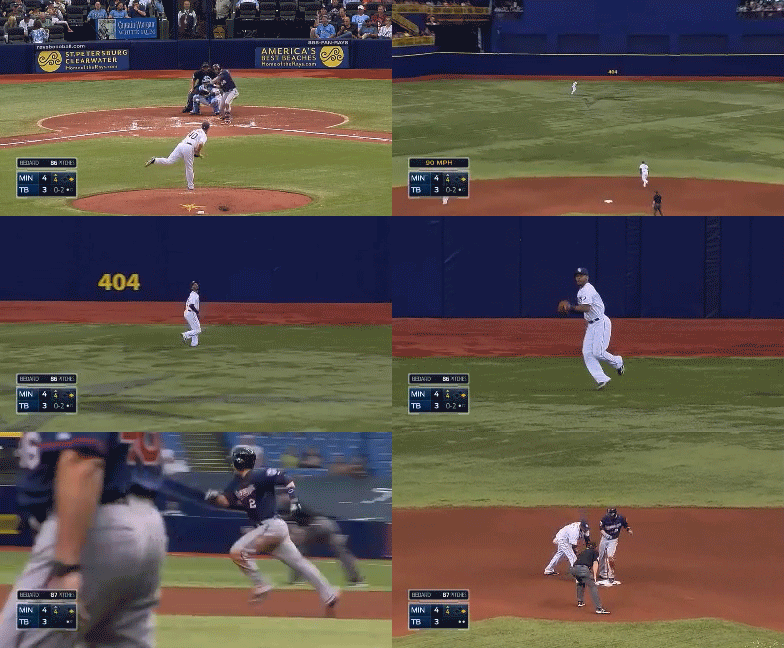
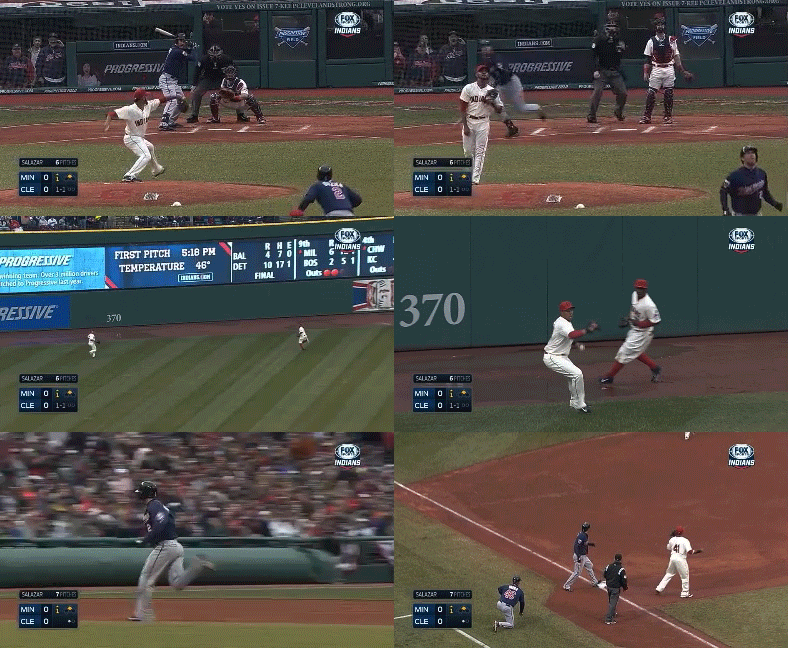
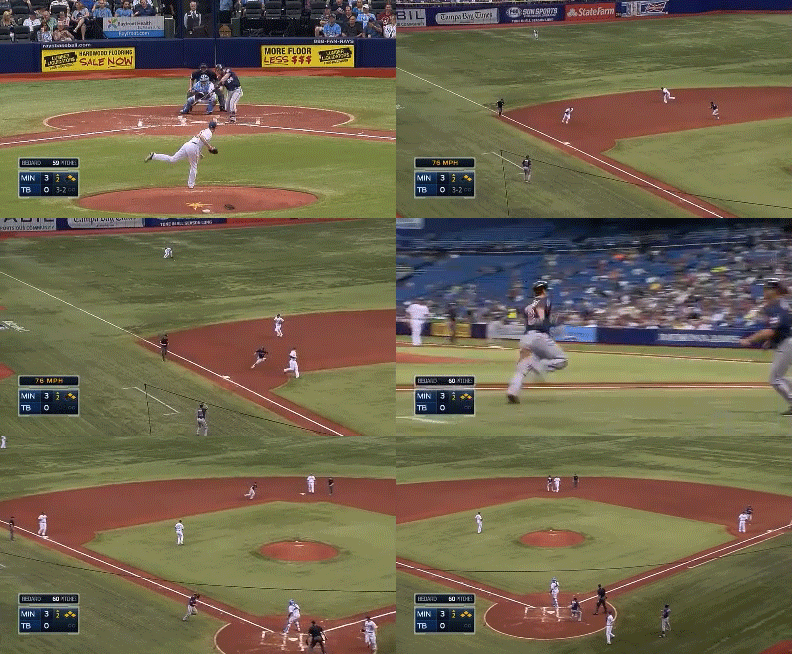
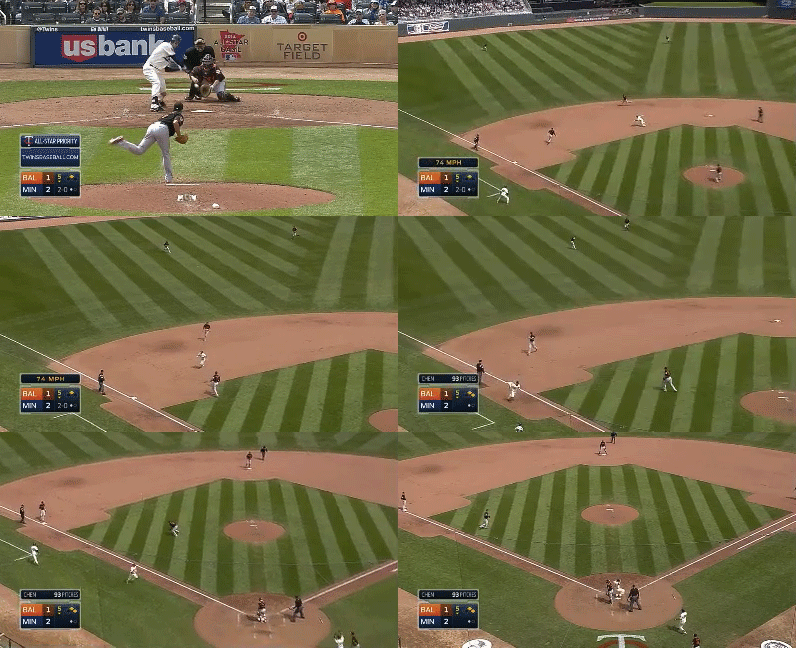
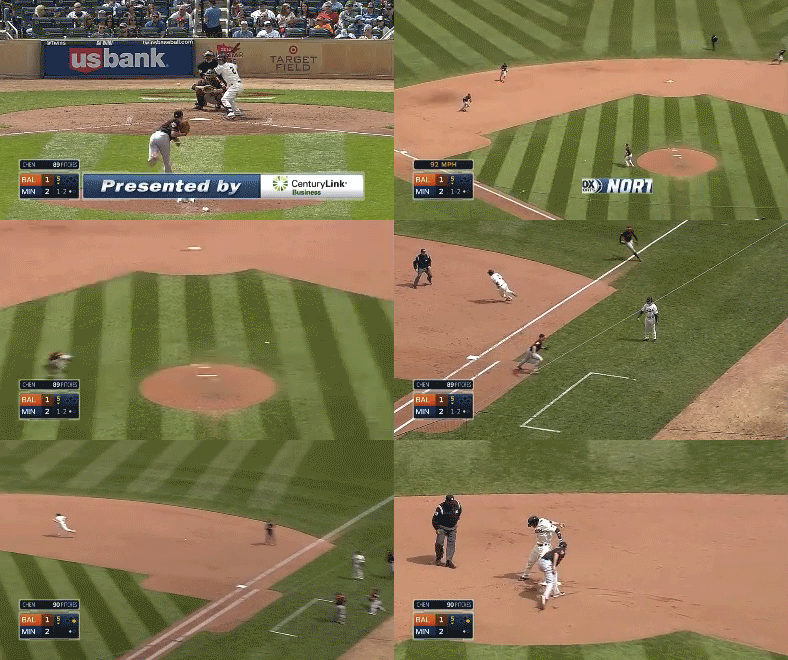
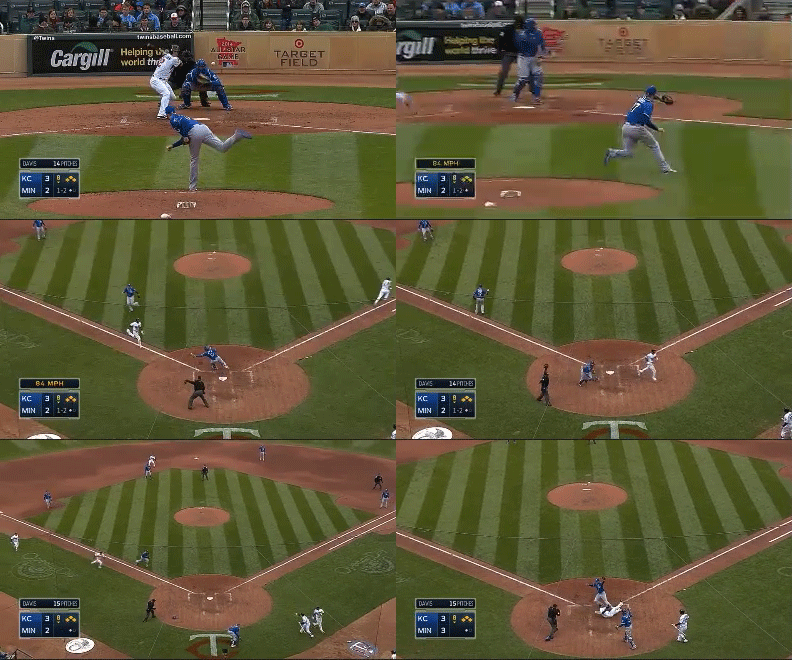
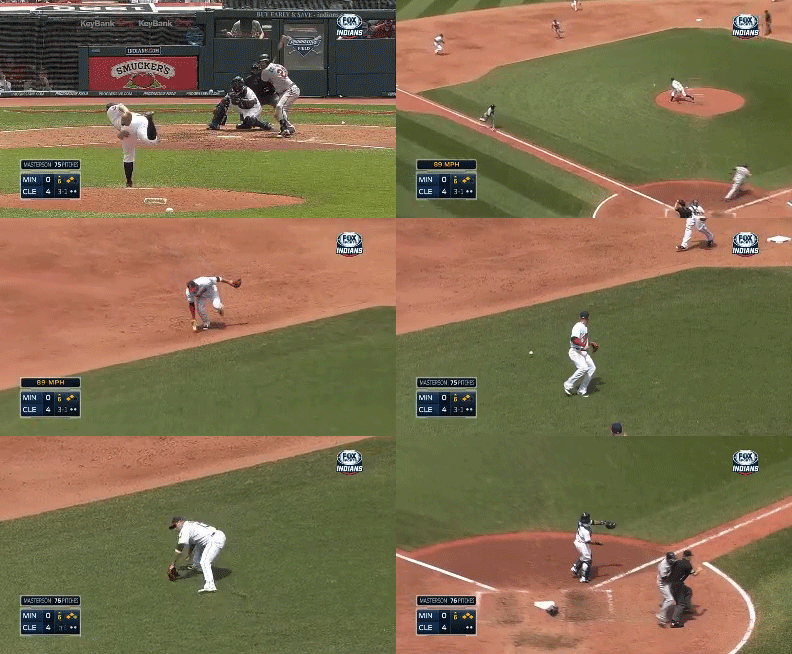
Using the incredible, amazing Baseball-Reference Play Index, I was able to identify 25 instances this season in which Brian Dozier took an extra base. Some of them were ordinary, but some were not. Let’s take a look at some of the ones that were not:

OK, this one’s not really out of the ordinary, but that’s why I’m getting it out of the way now. Brian Dozier does this, like, all the time. It’s one thing to go first-to-third on singles to right field. Dozier goes first-to-third on singles to center, regularly. I could have put five or six examples of this exact thing happening, but that would just be silly. Just trust me when I say if someone hits a single to the outfield and it’s not a hard liner to left, Brian Dozier is probably going to just put his head down and go first-to-third.

Again, it’s one thing to tag and advance when the ball is hit to the opposite side of the field. Far less often do you see a guy tag and advance to the base which is closest to the outfielder that caught it. Now, to be fair, the ball hit to Desmond Jennings was pretty deep in center and Michael Brantley was moving back when he caught his. But it’s more about the fact that Dozier is able to recognize these things and know his speed well enough to take the extra base.

Here we have a couple of ground ball singles to left field in which Dozier scored from second. These are the type of things that, when they happen in the midst of a game, can easily go unnoticed. But when they happen repeatedly over the course of a season, they really add up. Neither of these are super aggressive displays of baserunning, but they were hit to corner outfielders, who are closer to home plate than the center fielder, and not everyone scores these runs that Brian Dozier scored for the Twins.

Now for the fun stuff:

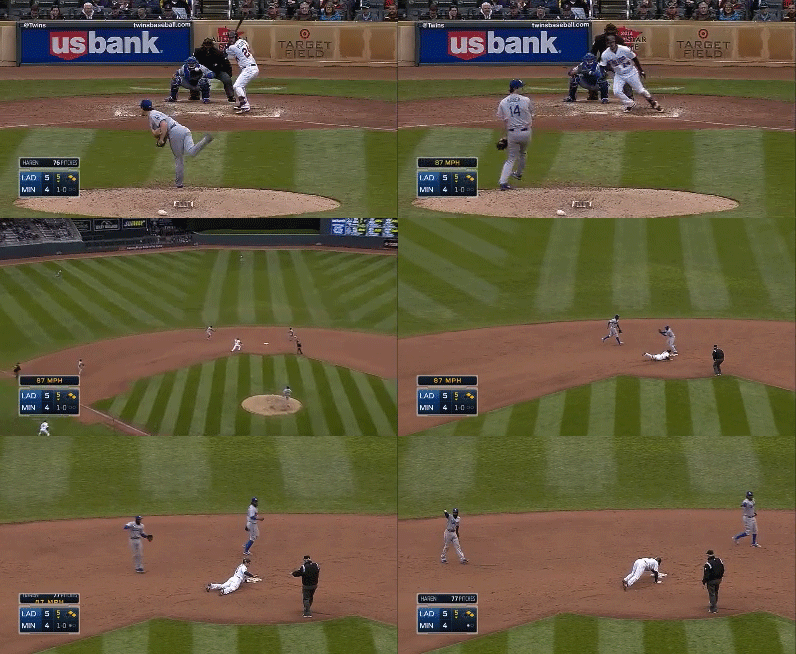
Here, Manny Machado almost makes an incredible play at third base to prevent a Brian Dozier infield hit. However, “almost incredible” sometimes become troublesome when you have to stretch the limitations of your physical ability to do so. That was the case for Machado on this play, and the ball skips away from the first basemen, though just barely. I don’t know if Dozier didn’t realize how little the ball actually skipped away, or if he just felt like being aggressive. Either way, it worked out and he turned a slow chopper to third into a double.

Here, Wade Davis decidedly did not have to stretch the limitations of his physical ability to make this play, yet it still resulted in an error. Again, the ball really didn’t skip that far away. Again, Brian Dozier didn’t care and took the extra base anyway. This one resulted in a run that he scored from second base when the ball barely made it to the pitchers mound.

Here we find, again, Brian Dozier scoring from second on a ball that never left the infield. This one happened just last week. Now, I don’t know how much baserunning goes into pre-series scouting reports, but if it does, Asdrubal Cabrera should have known that one of the most aggressive – and successfully aggressive – baserunners in the league was on second base. Either way, Cabrera gave up on the play and turned his back on home plate just long enough for Dozier to manufacture a run with his legs.

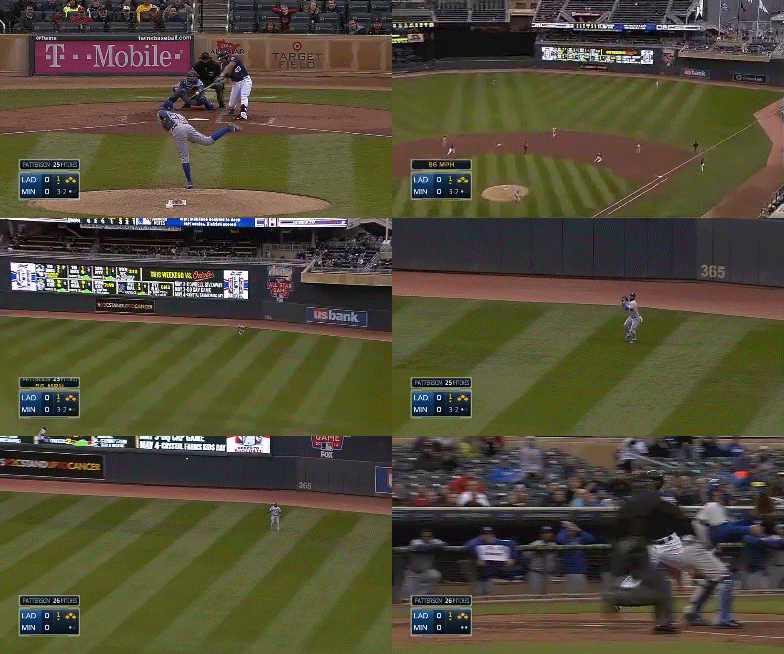
*BONUS* BONEHEAD YASIEL PUIG GIF:

This one doesn’t say much about Dozier, as pretty much anyone in baseball would have scored from third on that. What’s humorous is Puig, in the first inning of a 0-0 ballgame, bypassing the cutoff man and throwing all the way home, nearly from the warning track, allowing every runner to advance in the process.

So what about the times Dozier has been thrown out? Surely, with a baserunner as aggressive as Dozier, he is bound to misjudge a ball or his own speed every now and then and cost his team an out. Let’s look at all the times Dozier has made an out on the bases this year:

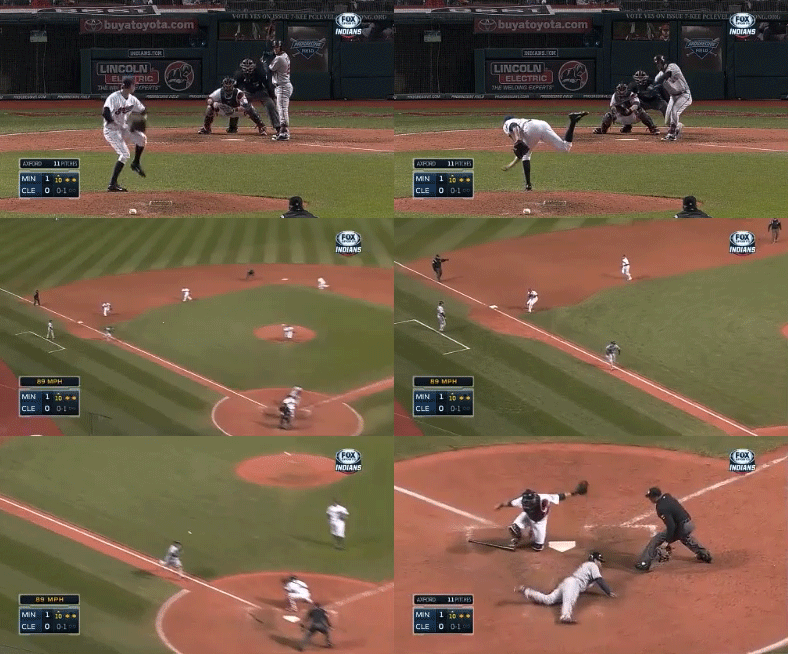
And that’s it. The first one, Dozier was originally called safe until Don Mattingly successfully overturned the call with a challenge. Either way, it wasn’t the fault of Dozier being overaggressive or really Dozier’s fault at all. Nothing you can really do in that scenario. The second one, Dozier got a little aggressive, but the Twins had just taken a 1-0 lead in the 10th and he was likely running on any ground ball contact. It was a mistake, but it wasn’t an entirely costly mistake given the situation.

So there you have it. That’s how a guy like Brian Dozier can be among the most valuable baserunners in the MLB despite not being a premier base-stealer. There is being aggressive, and there is being smart with your aggression. Dozier has been able to take the extra base as often as any player in baseball and only has one real mistake to show for it. Last season, Dozier impressed with his surprising power. This season, the power has continued, but what he has done on the bases may be even more impressive.


Run, Don’t Walk, to Buy Pedro Alvarez Stock

At first glance, it looks like Pedro Alvarez is doing exactly what we thought he would this year. He’s hit 8 long balls and is sporting a Mendozian .210 average, which somehow falls below his pre-season expectations of being in the .230 range. Most fantasy baseball outlets are sounding alarms and wondering aloud how much longer owners can live with his team killing average. In reality though, Pedro is producing a familiar stat line but is getting there in a very different way and mostly through bad luck.

It still feels early in the season but there are already some stats that have stabilized and are now significant for evaluating how players are performing. For when statistics stabilize I’m using this terrific post from 2011 (http://www.fangraphs.com/blogs/525600-minutes-how-do-you-measure-a-player-in-a-year/) which is definitely worth a read on its own. The cliff notes needed for this article are that when statistics stabilize, they start to tell us more about a hitter’s current season than league averages do. Statistics regress to the mean but when a statistic stabilizes we equally weight an individual’s performance with the league average when creating future projections.

Pedro is at the 150 plate appearances plateau and three key statistics have already stabilized and are now telling us more about his performance this year than league averages or his career stats, they are swing percentage (swing%), contact rate (contact%), and strikeout rate (K%).

2014 Pedro is swinging at 44.4% of pitches. This is down from swinging at 50% of pitches last year and is close to being a career low (in his call up season his swing% was 43.7%). This doesn’t tell us all that much by itself. You can get yourself in bad counts by watching strikes go by just as much as you can by swinging at balls. But, Pedro is making contact with 73% of pitches, four points above his career 69.3% average and almost a full 7% higher than last season. A hitter’s swing% first stabilizes at 50 PAs and contact% stabilizes at about 70-75 PAs, and this shows Pedro turning into a more patient and more selective hitter. He’s actually swinging less often than the league average and while the league average contact rate is 79% this year, Pedro has much more power than your average hitter.

The third stat I want to look at is the big one, strikeout rate. In each of Pedro’s first four seasons in the majors he has posted a K% north of 30%. The league average K% ranged from 18.5% to 19.9% during that time, so Pedro really excelled at striking out. Pedro’s K% through 150 PAs this season is only 21% though. Now it just stabilized, so there will probably be some regression towards his career norm but this is 9% lower than his career rate and is only .4% higher than the league average this year. I’m expecting this to regress, at least somewhat, because a 9% drop in K% is too good to be true but Pedro has definitely improved in this area and even regressing to a 25% or 26% strikeout rate would be a significant improvement.

All of these stats might look good but Pedro is still batting an abysmal .210, what’s up with that. The biggest culprit is his .209 BABIP. BABIP doesn’t every stabilize, if Pedro’s reverted to his career average (.292) he’d have a batting average of .267, if it reverted to last year’s rate (.276) he’d be batting .256. Home runs are BABIP-proof, there’s nobody to field them, and Pedro’s is off to a great start with 8 already. More of the non-homers are going to start falling for hits and barring injury, Pedro looks to be good for 35+ HRs and closer to a .250 average. Every fantasy team can use that guy. So before his bad luck starts to end, run out and buy low on Pedro.


The Fielding Edge: Why Pujols is No Cabrera

When Miguel Cabrera signed his big new contract with Detroit earlier this year, the response of this blogger and many other fans was — No! Specifically, the seeming albatross of Albert Pujols’ contract, and somewhat lesser ones of Prince Fielder and Ryan Howard, were cited as warning signs.

However, Pujols’ injury-hastened offseason, with extra rest, seems to have put a bit of a new spring in his step through taking the fasciitis out. His quick start en route to passing the 500-homer mark would seem to be good evidence of that. Even if a start this hot doesn’t hold, if he finishes the year at somewhere between his 2011 and 2012 levels, it’s a major turnaround and one the Angels will gladly take.

Fielding has been known to set Pujols at least somewhat apart from the other three. But, how much? More than one might expect. Indeed, Pujols overall might come off better than one might expect.

Here’s a check of all four, on total zone runs and ultimate zone rating per 150 defensive games.

Pujols: 96/6.2

Cabrera: -7/-2.0

Fielder: -38/-5.5

Howard: 14/-3.4 (really)

All numbers are for first base only for each player. Howard’s numbers make me raise my eyebrows a bit. They also make me think that we still haven’t “nailed down” defensive sabermetric calculations as tightly as offensive ones. Not just this, but differences between FanGraphs and Baseball-Reference make me say that.

But, before I go down that road, I’ll present one other first baseman’s figures. He’s a bit older, so we don’t have UZR or UZR/150 numbers for him, just total zone runs. You’ve “probably” heard his name among defensive first basemen a few times. I present Keith Hernandez.

Hernandez: 121

And so, Albert Pujols’ fielding neighborhood looks a lot better than one might think.

So, let’s go to Baseball-Reference next. Here, I’ll have all games, not just at 1B, included, for two stats over there: fielding runs and dWAR.

Again, the differences are notable.

Pujols: 134/1.9

Cabrera: -77/-12.0

Fielder: -93/-17.8

Howard: -46/-12.4.

A couple of notes. With B-R, Howard falls a lot closer to Cabrera and Fielder. On both, the idea mentioned by some bloggers and sportswriters, that teams and managers would have to some day worry about Fielder losing his range, is shown to be wrong. He never had it to lose, claims about his prowess at first aside.

Let’s also see what B-R tells us about the Merry Mex.

Hernandez: 117/0.6

Whoa; Pujols actually ranks better than him. Really?

Yes. Another statistic has further proof.

Hernandez was famed for his ability to start 3-6-3 double plays. B-R says he initiated 127 ground ball DPs of all types.

Guess what? Pujols is close behind with 121. After he recently turned his first one this season, I decided, just out of curiosity, to check these numbers.

The others? Not even close. Howard has about 80 fewer and Fielder about 75 fewer. Cabrera, with much less time at 1B, is more than 80 such double plays behind Hernandez.

This is about more than illustrating Pujols’ individual value as a fielder. It’s about team issues.

Cabrera could well be moved to DHing more than 1B already next year, if the Tigers don’t resign Victor Martinez. Fielder, instead of Mitch Moreland, should already be the Rangers’ primary DH. Howard is in the National League, and with a GM who still believes he has a serious shot at the postseason, which is preventing him from being traded into the  AL.

But, Pujols, still playing league average or a touch above at 1B, and likely to do so for a few more years, gives the Angels and Mike Scioscia more flexibility on making out lineup cards. For more details about all this, visit my blog post, please.


All Hail the New Bunt King?

On April 24, Danny Espinosa had a remarkable game. He bunted for a hit and had a solo home run to the left-field corner. The bunt was the remarkable part.

Danny Espinosa has seven (7) bunt hits so far in 2014. That’s more bunt hits than 28 MLB teams, in a tie for first place with the Marlins and Danny’s D.C. teammates. In fact, Espinosa’s bunts account for 35% of his total hits (7/20), and he’s only failed once.

This is so unprecedented that a better word would be “outrageous”. In 2013, Leonys Martin led the MLB in bunt hits with just 12. And Martin only succeeded 40% of the time that he tried getting on base with the bunt. I had to go back to 2011 to find a guy who pulled off the base-on-bunts 20+ times in a season: Juan Pierre attempted 62 and succeeded with 23.

Only one qualified hitter in recent (batted-ball data) history has done anything even slightly similar to what Espinosa is doing so far. Fully 20% of Willy Taveras‘ career hits were bunts; he succeeded nearly half (46%) of the time, racking up a total of 130 bunt hits, including 38 in the year 2007, which is the single-season record, even though he only played in 97 games (!!). Only Juan Pierre has more bunt hits in the batted-ball-data era, but he’s much less successful on a percentage basis.

There are many reasons to think Espinosa won’t follow in their footsteps. For one thing, he’s a very different hitter: not a powerless center fielder who relies solely on speed, but a homer-happy middle infielder with a dangerous strikeout tendency.

In fact, therein might lie an explanation. Last year, Danny Espinosa hit rock-bottom, plagued both by injuries and the stupid belief that he could play through his injuries. His collapse was uglier than Ron Burgundy’s, and he put up a .280 OBP in the minors. Now he’s on the comeback trail. The power is back. The strikeouts are back. The batted-ball profile in general is back to pre-2013 numbers.

With one big exception: the bunts.

I believe this is deliberate. Espinosa is trying to get on base, he’s trying to cure a predilection for infield pop-ups, he’s trying to re-establish himself against major-league pitching, and he’s trying to re-establish himself in a lineup where he’s currently filling in for an injury. He likes unorthodox approaches to reaching base, leading the NL in hit-by-pitches in 2011.

Given Jeff Sullivan’s recent series of posts about bunts, bunting is a tougher skill than we’d think. Danny Espinosa was always good at bunts. (Maybe we can convince Jeff to make GIFs of all seven bunt hits so far.) In 2011 and 2012 his bunt hit attempts succeeded about 43% of the time, nearly as good as Willy Taveras. He chipped in a few sacrifices, though not too many. He might commit to this stratagem until teams start expecting the bunt every time he steps in.

If Danny Espinosa wants to set records, the records are there for him to take. If he succeeds on even half his attempts, that’s a season record. If he succeeds 32 more times, that’s a season record. You’d be crazy to believe he will break those records. But you’d have been crazy to believe, a month ago, that he would have even had a chance.


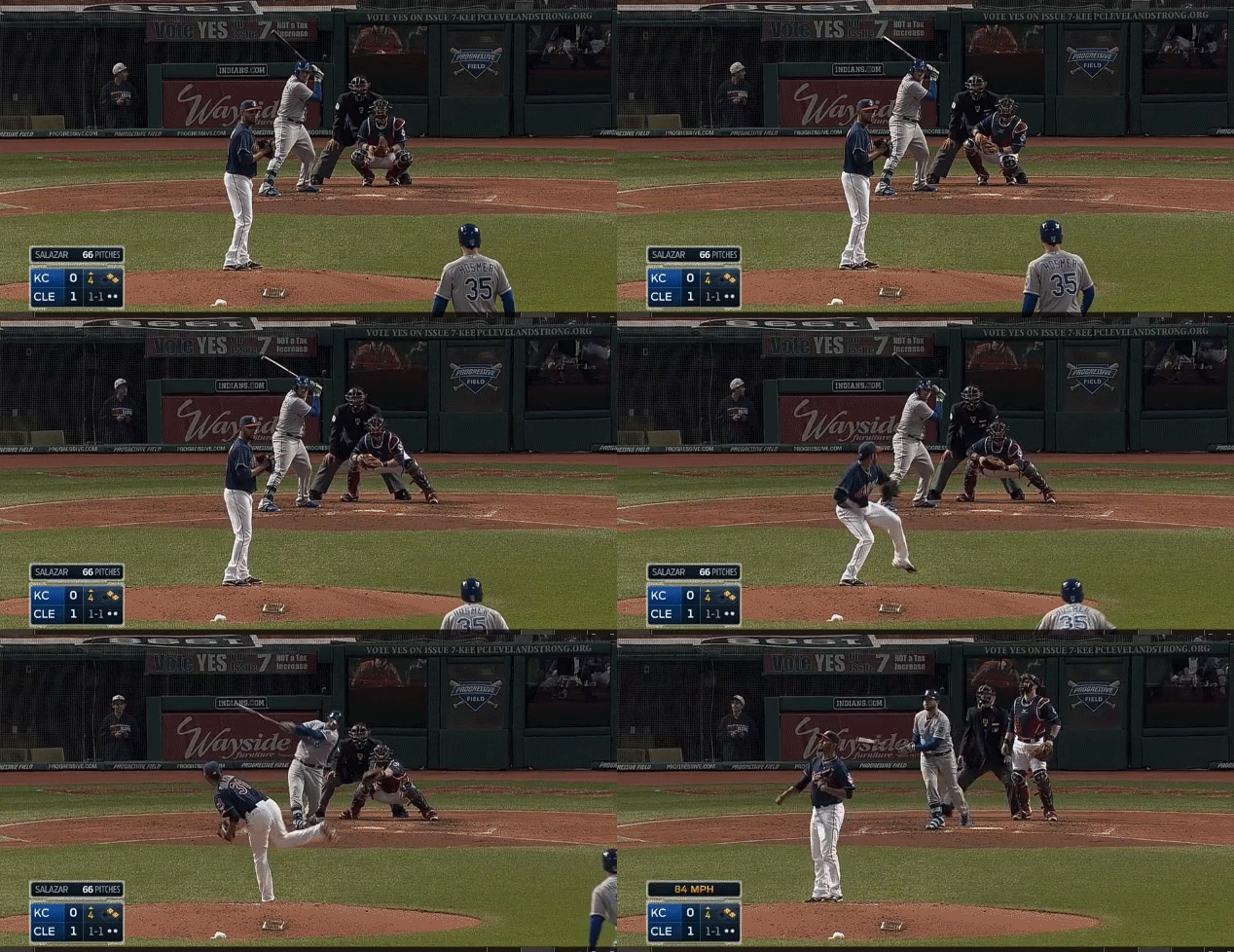
Danny Salazar, Not According to Plan

Last season, Danny Salazar was among a wave of hard-throwing young pitchers that made electrifying debuts down the stretch, falling upon the national eye during the postseason.

Salazar threw 52 regular season innings over 10 starts in 2013, posting a 3.12 ERA and 3.16 FIP while striking out more than 11 batters per nine innings. His 30.8 K% was second of all starting pitchers who threw at least 50 innings, putting him behind only Yu Darvish and right ahead of Max Scherzer. His 2.75 xFIP was third in that same pool of pitchers, trailing only Matt Harvey and Felix Hernandez. His 14.6% swinging-strike percentage was tops in baseball, beating Francisco Liriano’s second-place rate by more than a full percentage point.

For 1/3 of the 2013 MLB season, 23-year-old Danny Salazar was among the most dominant starting pitchers in baseball. But with that kind of performance comes high expectations, and thus far, unlike young peers Sonny Gray, Michael Wacha and Alex Wood, Salazar is not living up to expectations.

Through his first four starts, Salazar sports a 7.85 ERA and a 5.70 FIP. Strikeouts are down, walks are up, and he has allowed five home runs in 18 innings.

Despite how good Salazar was in 2013, those who follow him and/or the Indians will likely remember his season by two big swings from two big men in two big games.

To wit:

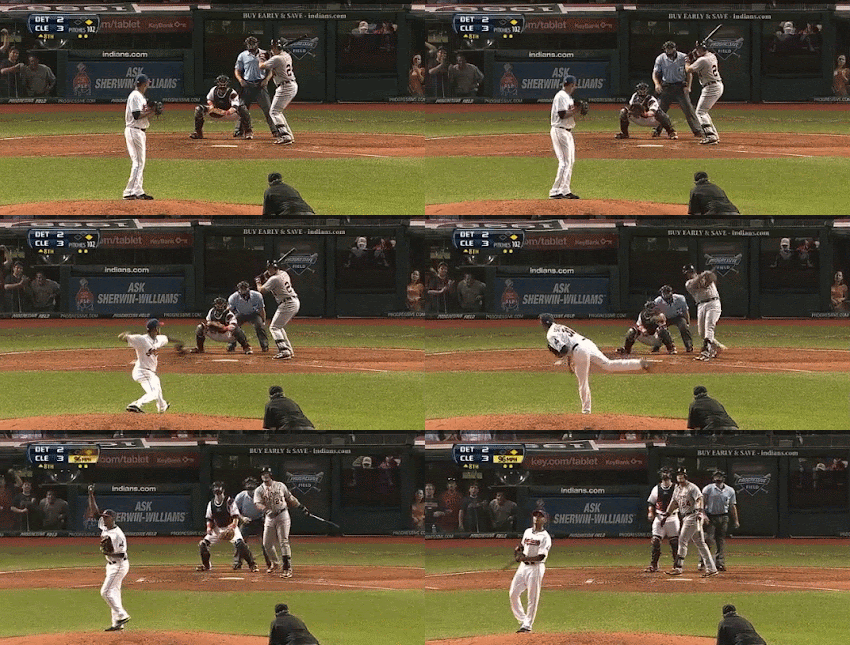
Miggy

Miguel Cabrera hit that on the first pitch with two outs in the eighth inning of a late season game between two divisional rivals battling for first place. It gave the Tigers a one-run lead, they went on to win and it was a key momentum shift in the American League Central race. Salazar had been dynamite that evening, striking out 10 Tigers and fanning Cabrera in his first three trips to the plate, until the best hitter in the MLB ultimately came out on top. It was a “welcome to the big leagues” moment right out of a screenplay.

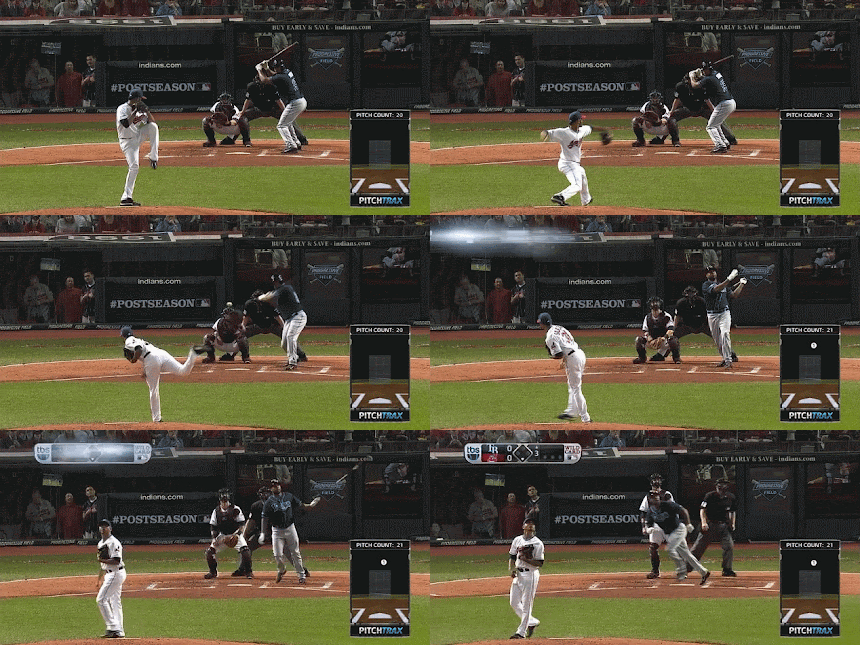
Delmon

Here, Delmon Young got a first pitch fastball in the third inning of an AL Wild Card play-in game and hit a no-doubter as no-doubty as any no-doubter could be. The Rays went on to win and Cleveland’s first playoff appearance in six years was gone as quickly as it came.

These two blemishes on an otherwise stellar 2013 campaign foreshadowed what Danny Salazar would struggle with early in the 2014 season.

Both these pitches were left up in the zone and Salazar paid for them. Elevated pitches are nothing out of the ordinary for Salazar. He works up in the zone often, as pitchers who can throw 100 miles per hour tend to and should do.

salazarzone

It contributed to some of his success last year, but it’s also contributing to his failures this year. There were two red flags in Salazar’s 2013 numbers that were concerning to begin with and are now trending in the wrong direction. The first was his inability to generate ground balls. Salazar’s ground ball rate of 34.4% would have ranked in the bottom 10 of qualified starting pitchers last season. To make matters worse, 13.7% of Salazar’s fly balls left the yard, also a bottom-10 figure. It’s tough for any pitcher to sustain success without generating ground balls or while giving up a lot of home runs. Combine the two and you’ve got a problem on your hands.

Danny Salazar knows he needs to get more ground balls. In spring training he was working on “being a little more consistent with keeping the ball down.”

That’s not exactly happening. Salazar’s ground ball rate has plummeted to 25.9%. His HR/FB is up to 18.5%. Let’s take a look at the home runs that Salazar has conceded through his first four starts of 2014.

No. 1 – Chris Colabello

hr1

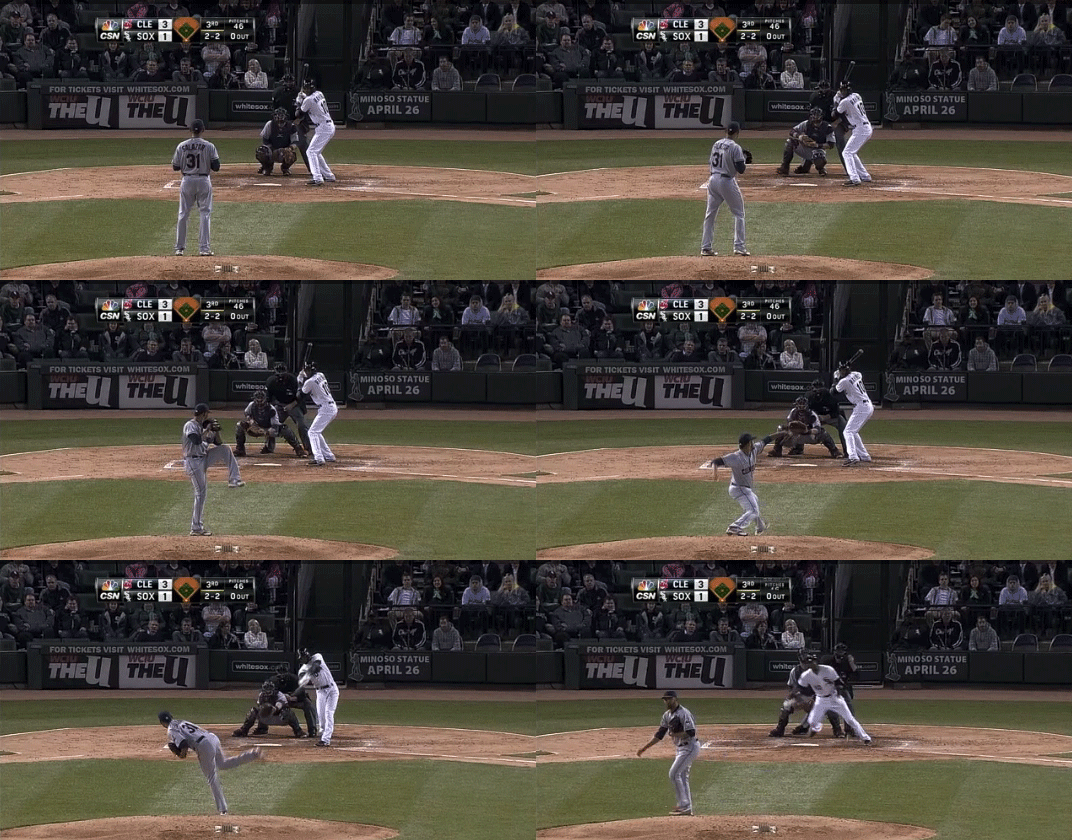
86 mph slider, elevated and left over the heart of the plate.

No. 2 – Alexei Ramirez

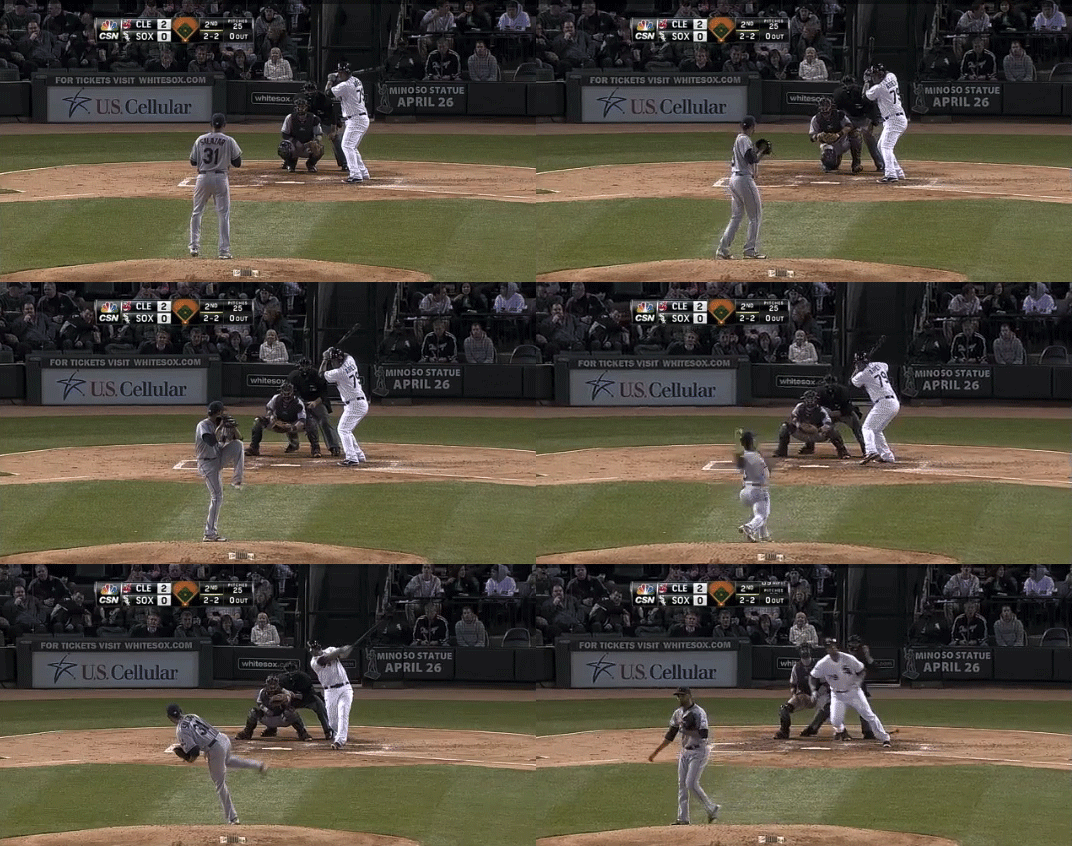
hr2

85 mph split finger changeup that was thrown right down the middle of the plate and stayed up for too long.

No. 3 – Jose Abreu

hr3

88 mph slider, left way up in the zone and over the heart of the plate. Can’t hang a slider much worse than that and Salazar knew it immediately.

No. 4 – Ian Kinsler

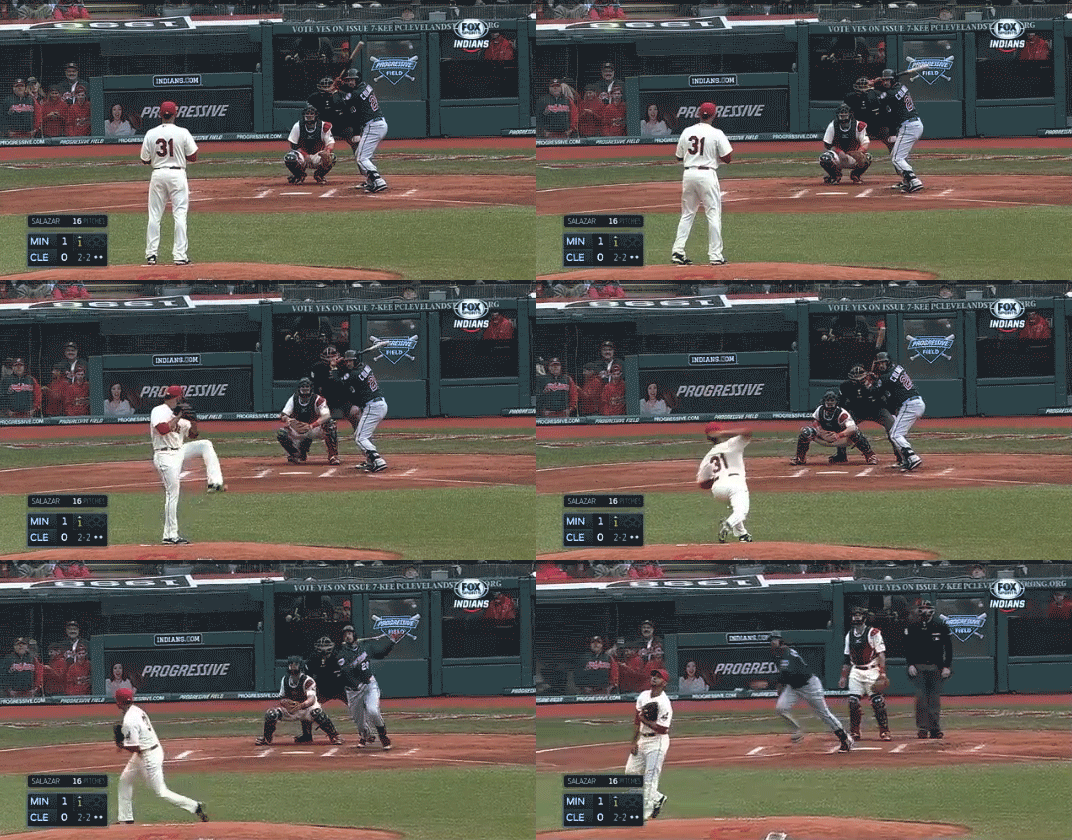
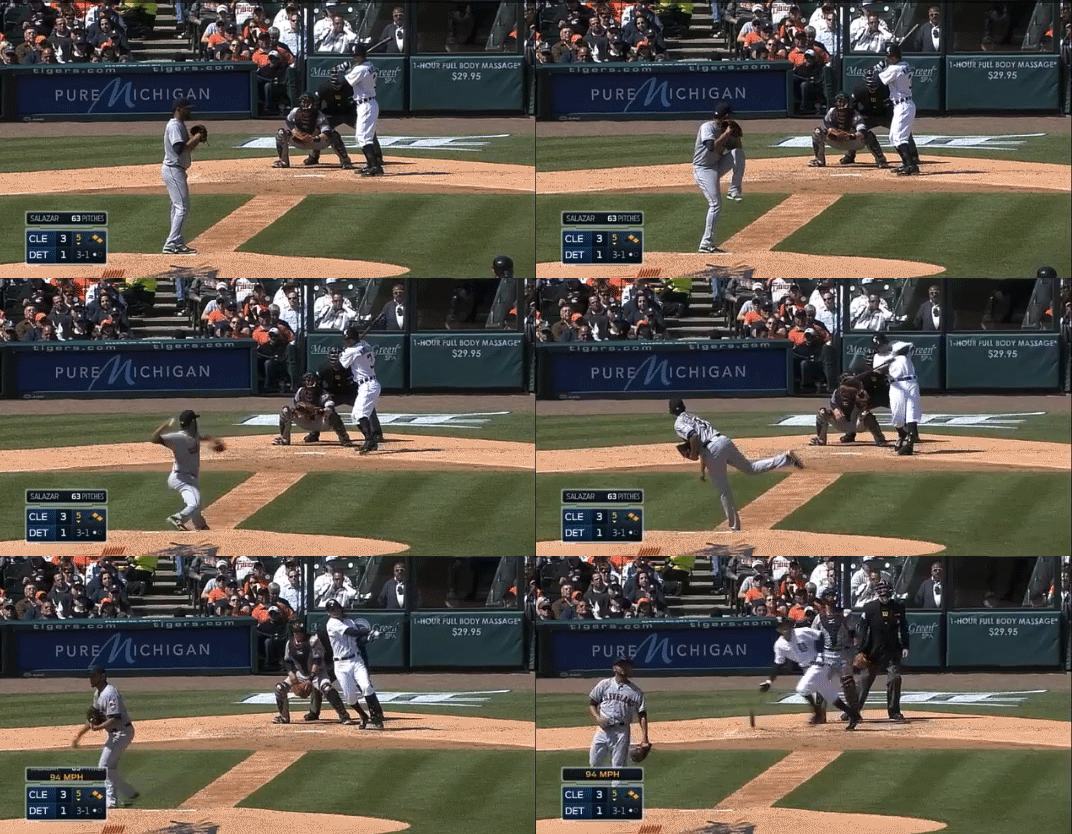
hr4

This one was a fastball. Flat and elevated. It was a 3-1 count and Kinsler knew the fastball was coming. 18 times in Danny Salazar’s young career has he found himself in a 3-1 count. All 18 times he has come back with a fastball. Kinsler knew Salazar couldn’t trust his offspeed stuff, sat on the fastball and put it in the left field seats to give the Tigers a 4-3 lead.

No. 5 – Mike Moustakas

hr5

84 mph slider elevated and left over the middle to an opposite-handed hitter. Might be even worse than the pitch to Abreu.

The slider clearly is an issue. Every time a batter has got a hit off Danny Salazar’s slider this season, that hit has been a home run. Consider this simple scatter chart of Salazar’s sliders in 2014:
slider
What you’ve got down at the bottom there is six sliders in the dirt, five of which went for balls. Of the remaining 20 sliders that weren’t in the dirt, only six were below the waist, where you want a good slider to wind up. That’s a lot of elevated, hittable sliders, as evidenced by the three in the middle there that went out of the park.

Then there’s the split change. This is Salazar’s out pitch. Its elite 22% whiff rate last year was the best in his arsenal and a result it accounted for nearly half of his strikeouts. However, it also needs to serve as his ground ball pitch, seeing his slider doesn’t generate any grounders, his fastball lives up in the zone and he doesn’t really throw a sinker or two seamer. Last season the split change had a 10.7% ground ball rate. This year, he has gotten only two ground balls with it and his rate is down to 2.99%. This could have something to do with the fact that, after watching video of his last start, Salazar believes he may be tipping the pitch. “With my changeup sometimes, I open up my glove too much,” Salazar said.

So, the split change isn’t getting any ground balls and he may be letting the batter know it’s coming. The sliders are all up in the zone and every time someone hits one it goes out of the park. Factor into the equation that his fastball velocity has dropped two miles per hour and its whiff rate has gone from 14% to 9% and its not hard to see why Salazar has struggled early on. All three of his pitches have had something wrong with them.

The Indians shouldn’t be so quick to pull the trigger on demoting him as some have suggested just yet, as this four game sample shouldn’t make us forget the elite production Salazar proved he was capable of last season. But that’s not to ignore that four games and 18 innings already make up nearly 30% of his major league body of work and his career ERA and FIP have already jumped to 4.35 and 3.83. With Trevor Bauer seemingly finding new life in Triple-A, if Danny Salazar doesn’t begin to correct these trends over his next several starts, you’ll have to wonder how long the Indians can let him work on trying to fix all three of his pitches.


Why is Bronson Arroyo Still Throwing a Changeup?

I respect the change-up. As a pitcher myself, I know how difficult it is to throw a good one (thus I don’t). It’s not the most glamorous pitch in baseball, but certainly an effective one if executed correctly. Plus, what constitutes a good off-speed offering reads like a laundry list of mechanical and ball path attributes that have to be repeated over and over again. Proper grip on the baseball. Delivery and arm speed must be identical to the fastball. Velocity needs to be lower than the fastball. The ball should move (ideally both horizontally and vertically) and spotted in a good location. And lastly, there’s the intangible pitching IQ of understanding when to throw it.

The Diamondbacks Bronson Arroyo and his change-up seem to be missing a majority of these qualities… but for some reason he continues to throw the darned thing. 16% of the time in 2013, in fact, and already almost 18% of the time this season. I’m baffled.

Now, of course I can’t know what’s going on in his head (although if someone can point me to an all-encompassing Pitching IQ metric I would be more than happy to apply it). And I also can’t measure his arm velocity at release. So I can’t quantify all of his deficiencies. But there is, fortunately, hard numerical and visual data showing he’s lacking the necessary skills to throw a change-up well.

Let’s look at Arroyo compared to pitchers who threw more than 200 change-ups between 2011 and 2013:

Movement:

Since change-ups (especially the circle change) tend to move down and to the right for right-handed pitchers versus down and to the left for southpaws, absolute value of x-Mov and z-Mov is used to standardize axis movement for both.

2011-2013 Abs(x-Mov) Abs(z-Mov)
League Average 7.17 4.30
Arroyo 6.00 3.60

I’ll give him a C- for movement. F’s are left for the likes of a Samuel Dedunowho posted a whopping 0.3″ of lateral and 1.6″ vertical (ignoring the natural pull of gravity) movement in 2013.

Velocity:

Again, keep in mind this does not include all pitchers, just ones who have thrown 200 or more change-ups between 2011 and 2013.

2011-2013 vFA (pfx) vCH (pfx)
League Average 90.9 82.9
Arroyo 86.6 78.2

When batters are already sitting on a below average fastball, it’s fair to say it won’t take much of an adjustment to catch up to the change. Below average may even be an understatement. There are only 12 guys in this data set of 275 with a lower average vFA. Jamie Moyer is one of them.

D+.

Location:

There are very few pitchers that can have success locating the change-up for called strikes.  Fernando Rodney being the freak off-speed guru who fools batters looking with a career 46.2 Swing%, 48.8 Zone% and 1.51 Val/C on the change. Typically the best change hurlers induce swings. And those swings either result in bad contact or a flat out whiff. But location of the pitch is still overwhelmingly crucial to achieve either.

I’ll use 2013 poor contact master Hyun-Jin Ryu and Braves injured whiff king Kris Medlen for illustration.

Ryu, with his 56.2 Swing% and 70.9 Contact% is looking to get bat on ball with the change. Ending 2013 with a .187 BABIP, the pitch worked beautifully to induce dribbling grounders (54.7 GB%) to an already above average Dodgers defense (3.1 UZR/150). How did he do it? Pin-perfect location (courtesy of Brooks Baseball).

 photo 74025e6d-0ca0-4068-802d-d2575977591e_zps07ccd3d1.png

Arroyo also induces hitters to get the bat on the ball with the change… at a whopping 85.5 Contact% rate. But is he getting poor contact with the pitch? I somehow don’t think .600+ SLG and 23 HR  over the past three full seasons would constitute bad contact. Let’s compare his zone chart with that of Ryu.

 photo 53238386-6da5-4f8b-9c21-44707dbd34a3_zpsc37ace95.png


Not quite, Bronson.

“But what about whiffs?” you ask. With a 6.8 career SwStr%, batters aren’t swinging and missing Arroyo’s meatballs either.

Let’s look at Medlen who owns a 27.5 career SwStr% on the pitch for comparison.
 photo 312d97a3-59b7-474d-8d46-43e4196b2988_zps9c5924cd.png

Pretty, no?

I’ll give Arroyo a D- for location. At least he’s not hanging them up and in on lefties.

So overall grade: barely passing.

I really don’t know what to say at this point. I’m miffed. Confounded. And who is the culprit to blame in the grand mystery of why he continues to throw this sub-par pitch? Batters have already gone deep on it twice in 2014. Is it the catchers? Do we point the finger at Devin MesoracoRyan Hanigan, and now Miguel Montero for keeping blind faith and confidence? Are these guys cursed with chronic short-term memory loss? Or do we blame Arroyo for stubbornly going out there outing after outing and continuing to shove that ball in the back of his palm and firing away? If that’s the case, I get it. I’m a pitcher. I’ve stood there on the mound and though, “This next one will be better, guys. I swear!”

So, please, Bronson. In the end, there is really nothing good that has come from you throwing the thing so often. I like you. I really do. I will forever be indebted to you for giving my beloved 2004 Red Sox their first World Series since “tarnation” was a common curse word. But please. Enough change-ups already.


Alden Carrithers and Being Good Enough

Alden Carrithers is twenty-nine years old, has zero major league at-bats, and has never hit more than three home runs in any minor league season.

Which is kind of why he’s so amazing, because he just might be relevant. Perhaps Carrithers won’t be relevant to the all-star game, or perhaps he’ll never even be relevant to major league baseball. What that doesn’t mean, however, is that he shouldn’t be. Carrithers is never going to play in the midsummer classic — that’s an assumption that can be made with a high degree of certainty — but there is a good case to be made that he belongs in Major League Baseball.

Carrithers has only one really plus tool, but that tool is pretty fantastic. This is Carrithers’ seventh season in the minor leagues, and in every single one of them he has more walks than strikeouts. That likely won’t hold up in the major leagues, but it will continue to at least some extent. Reaching base often for free while rarely taking the automatic trip back to the dugout is the kind of thing that generates value, and it’s the kind of thing that Alden Carrithers is. This isn’t a novel, new concept. But it is something that’s hard to always remember and realize, and really factor in to a player that would otherwise be labeled as Quad-A at best.

Because as much as this is, this really isn’t an article about Alden Carrithers. It could be about Mike O’Neill who had a ridiculous 91 walks with only 37 strikeouts last season, or it could be about Jamie Johnson of the Tigers, who’s had many more walks than strikeouts in his past two seasons. But those guys have flaws in their games that are pretty obvious, and they’re all further away from proving themselves ready for the show than Alden. This is really an article about something-for-nothing guys, and how available they are.

A naïve argument against the necessity for an article that points out the possible worth of a player of Alden Carrithers’ type is that these guys exist in bulk. That argument is more arguing against the very premise of WAR itself, however, since replacement level is very intentionally set to where it represents just that — replacement level players. There aren’t an abundance of one WAR guys hanging around. If there were, WAR would simply be wrong. There are, however, an abundance of zero WAR guys hanging around, which is kind of the idea.

Back to Alden, and why he’s probably not just another one of the zero WAR guys. The bane, of course, is his power. He’s never hit more than three dingers, as mentioned earlier, and his ISO has fluttered in the range of .066 without ever reaching higher than his rookie-ball .114. The literally outstanding plate discipline makes up for a lot of that, but in and of itself the plate discipline isn’t enough to make him a major league player.

His defense projects to be solid without being fantastic. There’s a lack of data on defense in the minor leagues, but the majority of scouting reports on him have been generally agreeable without being glowing. He can play second base, which gives him a little immediate boost in value, while also being able to pitch in at third base as well as left field. He’s only really projectable defensively at second base for any long-term stint, but that’s not a terrible thing. Second base is currently the third-weakest position in baseball from a hitting perspective — only catcher and shortstop are worse. And while shortstops and catchers are often able to add value simply by being capable of playing catcher and/or shortstop, the same often isn’t true with second basemen. The basic point is that second base is probably currently the worst position in baseball. It’s really hard to be good enough to play major league baseball, but if one is inclined to do so then second base is probably a good choice.

His speed is of the same ilk as his defense, in the sense that it is solidly useful as well as unspectacular. He’s stolen bases at a 77% clip throughout his minor league career, but he’s only stolen 89 bases total, suggesting that while his baserunning isn’t prolific it is in fact solid. This is further backed up by his Bill James speed score that has hovered just north of 5 throughout his career (suggesting just north of average). Oliver projects Carrithers to have a WAR/600 of 1.8, which is a reasonable projection although it probably slightly over-rates his defense (6.3 runs above average) while under-rating his running (-1.6 runs above average). The wOBA projection is at .297, which is roughly in line with Steamer and ZiPS.

All that said, if a starter goes down and Carrithers has to play for a quarter of the season or so he will likely contribute about half a win. A second baseman will probably go down this season, and he will probably be replaced with a zero WAR level player. Ryan Goins is currently the starting second baseman for the Blue Jays, and he’s a zero WAR player. Last year Dan Uggla became terrible and the Braves replaced him with Eliot Johnson who ended the season as–wait for it–a zero WAR player. Meanwhile Carrithers was available via a phone call, forty miles down the road at Triple-A Gwinnett.

This past winter, Carrithers was basically available for anyone who wanted him as a minor league free agent. The Oakland Athletics picked him up, and he’s currently at their triple-A affiliate Sacramento in the PCL. The A’s already have Callaspo, Sogard, and Punto playing second base at the major league level, all of whom are probably a little better than Carrithers. But Carrithers also isn’t that much worse than those guys, from a total value perspective. If any or all of those guys go down the A’s won’t be hurt that much, and it cost them nothing. It’s this sort of thing that (along with a lot of other sorts of things) gets a team ahead in a game where everything can feel random. The A’s, after all, are still moneyballing. That hasn’t stopped yet.

Carrithers will probably never wear a uniform in a major league stadium. But if he does, it will probably be the kind of uniform-wearing that will help the team he’s playing for win baseball games. Something for nothing, is a pretty good way to win.