Archive for Player Analysis

xBABIP Experiment: Mark Kotsay

I am tired of Mark Kotsay. I am tired of his automatic 4-3 ground outs. I am tired of his lazy fly balls to left center. I am tired of his .190 batting average with runners in scoring position. I am tired of his .688 OPS. But most of all, I am tired of people in the White Sox organization defending Mark Kotsay. From Ozzie Guillen to Hawk Harrelson and Chris Rongey, the excuses are coming from every corner of the organization. And as an objective White Sox fan, the constant excuses are getting tiring. Luck or no luck, Mark Kotsay is a bad baseball player, that much is for certain.

Kotsay does nothing well and he contributes nothing on the field to this White Sox team, as shown by Mark Kotsay’s -0.6 WAR, good for the fourth worst in all of Major League Baseball amongst players who have at least 280 plate appearances. This shouldn’t come as a surprise, as of this moment, Mark Kotsay is hitting .228. Yet you have Ozzie Guillen saying things like, “Personally, the numbers out there for Kotsay [are not what] he deserves.” Followed by…“You can ask his teammates, you can ask [hitting coach] Greg Walker. He should have better numbers than what he has.”

You can ask any average White Sox fan or anybody in the White Sox organization and they will say that Kotsay has been unlucky or he “deserves” better. However, just how much better? Fortunately for us, the great people in the sabermetric community have come up with something that tries to battle this thing called luck. I think everybody knows of BABIP by now, but there is something better, something more contextual: xBABIP (Expected Batting Average on Balls In Play) . The concept is simple, take the mean batting average of line drives, ground balls, and fly balls that are not home runs, then create a BABIP based on those averages.

So what if Kotsay wasn’t lucky or unlucky? What if this was a perfect world where the average always happens? For the record, Mark Kotsay is a good player for this little experiment since his career offensive numbers are about as average as you can get. Currently, Mark Kotsay’s xBABIP is .269. This is more or less based on his line drive rate of 15.9%. His actual BABIP is .239. So as you see, he has been pretty unfortunate as that’s a 30 point disparity. Now let’s take this a step further, let’s say that .269 xBABIP is his actual BABIP. Mark Kotsay has hit 222 balls into the field of play (this does not include home runs), if he gets hits 26.9% of the time on those 222 balls, he would have 60 hits. Add his 7 home runs to those 60 hits and you have 67 hits in 258 at bats, which comes out to a .259 Batting Average. What about his On Base Percentage? Taking those 67 hits while adding his 30 walks divided by his 286 plate appearances, we would get an OBP of .336. So far so good right? Looks like Mark Kotsay would be a decent ballplayer if it wasn’t for those “hang wiffums” right?

Hold on just a second here, we can also apply this to his Slugging Percentage. We can play the rate game, which is a dangerous game to play, but we’ll do it anyways. Of the 53  hits Mark Kotsay has put in play, 38 have been singles, 13 have been doubles, and 2 have been triples. So from this, we can see that 71% of Kotsay’s non-home run hits have been singles, 25% have been doubles, and 4% have been triples. As I said before, this is a dangerous game to play, almost a fallacy, but since Kotsay does have an appropriate sample size here, it might be safer than usual. So taking these new numbers to his 60 expected hits, his new hit figures are 43 singles, 14 doubles, and 2 triples. This would result in a Slugging Percentage of .414. By adding Kotsay’s expected OBP and SLG together we come up with a .750 Expected On Base Plus Slugging or OPS, which is just about average.

Alright, so how do these new expected rates affect Mark Kotsay’s value? If we calculated an expected wOBA from these newly calculated values, Mark Kotsay would have a .329 Expected wOBA,  just about average. We can then calculate this into a run value to produce a new expected WAR. In this case, Kotsay would have produced -0.99 batting runs (without ballpark adjustment) in comparison to the average replacement player, much better than his previous rate of -6.2. So in this case, Kotsay’s WAR goes from -0.6 to -.08. A half win difference can go a long way at times.

So what does this tell us? Well first off, it says that Kotsay is a very average hitter in a luck-isolated world and average hitters should not be DHing 1/3 of the games for a team that already has issues scoring runs.  It also tells us is that Mark Kotsay has no place on this current White Sox team. He is a replacement level player who is only capable of DHing and playing 1B and that’s even if he hit like the “deserved” to hit. With Mark Teahen coming back and Brent Lillibridge already on the team, this team could be incredibly versatile. Isn’t that what Ozzie Guillen wanted? Isn’t that why Ozzie said no to Jim Thome, who is clubbing the ball for the rival Twins and is also a great clubhouse guy? This love affair with Mark Kotsay has gone too far. He is in fact costing this team on the offensive side of the ball. I would have no problem if Kotsay stays on this team as a pinch hitter and starts maybe once a week; he’s apparently a good guy in the clubhouse (as is his wife, I imagine). But the fact that this replacement level player has played 3/4 of this team’s games is disturbing. With the way that this situation has been tended to, you’d think the White Sox’ new slogan would be something along the lines of “White Sox Baseball: Here to Make Friends, Not to Win”.


Gavin Floyd and xFIP

After getting shelled by the Texas Rangers on June 2nd, 2010 (2.2 IP, 6 earned) Gavin Floyd’s ERA weighed in at a rotund 6.64, to the uninitiated it would appear that he was having a terrible season, but what is the truth?  During Floyd’s early season struggles it was pretty clear that luck was not on his side as his BABIP in April was 369 and in May slightly better but still high at 343, while his strand rates during those months were 55.8% and 66.8 un-respectively.  Floyd is throwing harder (FB velocity 2009-91.8, 2010-92.4), missing just as many bats (2009 contact%-77.8, 2010-77.0) and even getting hitters to chase his pitches more often (2009 o-swing%-27.6, 2010-28.3).

Someone in my fantasy league made a comment regarding Floyd’s terrible season and I commented “outside of a brutal BABIP and low strand rate, Gavin Floyd has essentially been the same pitcher” to which I was basically ridiculed.  But as we can see from this chart, Gavin Floyd was and is the same pitcher and therein lays the beauty of advanced pitching metrics like FIP or xFIP and the use of the peripherals that help gather these stats (BABIP, strand rate, HR/FB etc).

  K/9 BB/9 BABIP LOB% AVG ERA xFIP
Apr 7.8 4.1 369 55.8 301 6.49 4.09
May 7.0 2.2 343 66.8 296 5.63 4.12
Jun 8.0 2.3 281 72.5 217 2.58 3.30
Jul 6.4 2.3 290 80.0 234 1.01 3.35
2010 7.4 2.7 320 67.9 261 3.87 3.69
2009 7.6 2.7 292 69.7 246 4.06 3.69


When we look at K/9, BB/9 and xFIP from April all the way through this year and even from last season’s totals we see what xFIP is attempting to do for us, take out all of the noise and some of the factors pitchers cannot control (such as what happens after the ball is put in play) and give us a real idea of how said pitcher is performing, relatively speaking.

Look at how steady the xFIP column is in particular, even when Floyd had a month in which his ERA was 6.49, his xFIP remained calm and cool at 4.09.  But just as important look at his unbelievable Bob Gibson-like 1.01 ERA from July, again his xFIP tempers this and brings us all back to planet earth as it checks in at 3.35.

This is simply breaking down who Gavin Floyd is as a pitcher and this is also a simple way to explain and show the value and usage of xFIP.  I think it also helps show how useless ERA really is when evaluating a pitchers overall value and performance. 

For those curious, since that June 2nd shellacking Floyd has gone on a hellacious run – 62.1 IPs, 45 hits, 14 BB – 52 K’s, good for a 1.74 ERA and 0.95 WHIP.  All things considered Floyd is having a career year, who would’ve guessed?


Cliff Lee Hates Walks

If Kevin Youkilis is the “Greek God of Walks,” does that make Cliff Lee his mortal enemy? It’s an interesting query to ponder, considering Cliff Lee’s complete refusal to walk batters this season. At this pace, Lee is set to shatter the single season record for K/BB ratio. Given that the record for highest K/BB isn’t as universally celebrated as the single season home run or RBI leaders, let’s take a closer look at Cliff Lee’s historic season.

The current record holder in K/BB rate is Bret Saberhagen, who posted a K/BB rate of 11.00 over 24 starts in 1994. By comparison, in 13 starts this season Cliff Lee’s current K/BB rate sits at 14.83. While the list of K/BB leaders is littered with players from the 1800s, recent players on the list include Curt Schilling, Pedro Martinez, Greg Maddux, Ben Sheets, and Carlos Silva. Since it’s difficult to compare players from the 1800s with players today, let’s take a look at how Lee stacks up against the recent control freaks.

Player               GS     K/BB     K/9     BB/9     FIP    WAR  WAR/GS
Cliff Lee            14    15.17    7.27     0.48    2.58    3.8    0.27
Bret Saberhagen      24    11.00    7.26     0.66    2.76    5.2    0.21
Curt Schilling       35    9.58    10.97     1.15    2.40    9.7    0.27
Pedro Martinez '99   29    8.46    13.20     1.56    1.39   12.1    0.42
Pedro Martinez '00   29    8.88    11.78     1.33    2.17   10.1    0.35
Ben Sheets           34    8.25    10.03     1.22    2.65   8.0     0.24
Carlos Silva         27    7.89    3.39      0.43    4.18   3.0     0.11
Greg Maddux          33    8.85    6.85      0.77    2.43   8.2     0.25

A quick look at the table reveals the true dominance of Cliff Lee this season. On a per start basis, Lee is set to post a better WAR than every pitcher on the list except Pedro Martinez. While WAR/GS is a crude way to predict Lee’s WAR going forward, it does tell us how incredible his performance has been in the first half for the Mariners/Rangers. It’s also worth noting that even though he struggled in his Rangers debut, Lee did not give up a walk, increasing his K/BB rate while decreasing his overall BB/9 on the season. Despite a K/9 rate in line with Saberhagen, Lee is on pace to best Saberhagen in every single category in the table. Outside of the big strikeout guys (Schilling and Martinez), Lee may actually outproduce every other player in the table.

Even though K/BB leader isn’t a highly distinguished title, it’s certainly a sign of a player’s dominance in a particular season. No pitcher in the history of baseball has shown the amount of control Lee has exhibited this season. Since Lee’s strikeout rates are only above-average, you might expect batters to make a lot of contact against Lee, leading to more hits and a higher WHIP. This hasn’t been a normal season for Lee, however. The lefty has posted a WHIP of 0.95 this season, the top mark in the league. Some of that can be attributed to luck, but his current BABIP of .291 is actually fairly close to his career average of .305. With the recent trade, however, it’s going to be tough for Lee to match or improve on his numbers going forward. Leaving Safeco (and the Mariners defense) and moving to Texas will affect Lee’s numbers slightly. Despite that move, Lee still has a chance to complete one of the finest seasons by a pitcher. Even if Kevin Youkilis is Cliff Lee’s mortal enemy, I think it’s safe to say that every hitter despises Lee, especially this season.

*This article was originally written for FoulPole2FoulPole.com.


Call-Up Time: Brett Wallace

With the Major League season at its halfway point, and the Jays quickly running away from the playoff hunt, it’s time to look at the top man in their minor league system and see if there’s room to work him into the everyday line-up in The Bigs. This would of course be Brett Wallace, acquired in the Roy Halladay trade this off-season in a three-way deal involving Philadelphia and Oakland. Brett started his pro career at third base, but was moved to first base to start the season in order to mitigate his defensive shortcomings. This also works out nicely for the Jays because the only one in Wallace’s way is the incumbent Lyle Overbay.

Overbay has been a Blue Jay since 2006, and hopefully Toronto GM Alex Anthopoulos makes this year his last. Praised for his defensive abilities (all too often by the Jays’ commentators) he has actually been a below average defender so far this year with a UZR of -1.5, which doesn’t make him a laughing stock, but also doesn’t make up for his below-average .320 wOBA, or (almost exactly average) .334 park-adjusted wOBA. But when you consider that he’s playing the most “hitter-friendly” position, average just doesn’t cut it. So if Overbay is an average to below-average player, is Wallace an upgrade?

Brett Wallace has produced a solid .300/.362/.503 triple-slash in AAA Las Vegas, but with the Pacific Coast League being hitter-friendly we need to take these stats with a grain of salt. Thanks to StatCorner, though, we have a park-adjusted wOBA for Wallace, and it is an above-average .361 wOBA. Expecting it to drop when he goes to the majors, Wallace still projects to be an average hitter and at least as good a hitter as Overbay has been so far this year. Throw in the hitter — and especially HR — friendly nature of the Rogers Center, and Wallace could be a fairly productive player in the Jays’ power-hitting line-up. While it will be hard for Wallace to keep his batting average at the .300 mark, having a 23.2% line-drive rate in the minors just reeks of above-average BABIP (if he keeps it up) which should help him to a sustainable .270-280 avg at the Major League level.

The only problem now is getting rid of Lyle Overbay. The Jays are looking to be big sellers at the deadline, with John Buck, Alex Gonzalez and Lyle Overbay himself being UFAs. All three of these guys should be moveable to teams with a weakness at thin positions (Catcher and Shortstop). Overbay has also been hitting better as the season progresses and could look like an attractive and cheap option for a team like Tampa Bay who is lacking at the DH spot, or a NL contender such as the Reds (as a world series DH) or the Giants. He could conceivably bring in a B- or C+ prospect, depending on how much of his salary the Jays are willing to pick up. With the Giants also lacking at shortstop, the Jays could package the two together and try to pry away a high-level prospect from them, although a Bumgarner is probably out of the question.

All in all, the Jays should actively be looking to shop Overbay ASAP and give Wallace a good long look this season to see if he can cut it at the major league level, and thus get a better idea of where the organization is at moving forward


Stephen Strasburg Should Be an All-Star

What is the All-Star Game really about? Joe Posnanski ponders that question in his most recent article.While Posnanski doesn’t answer the question directly, he presents the different opinions of the All-Star Game. When I think about the All-Star Game, I tend to use a combination of two opinions Posnanski presents.

• It’s all about watching the best players in baseball.
• It’s all about watching the best players IN THE FIRST HALF (which is a different thing).

Following that line of reasoning, there is no doubt in my mind that Stephen Strasburg belongs on the NL All-Star Team this season.

Let’s examine the potential arguments against putting Stephen Strasburg on the All-Star team.

1. He hasn’t pitched enough to justify an All-Star selection.

Strasburg has pitched about as much as any reliever on either All-Star team this season. As a matter of fact, the only reliever on the team with more innings pitched than Strasburg is Pittsburgh’s Evan Meek. The skeptics are so quick to point out Strasburg’s lack of playing time, but very few actually seem to realize that most of the relievers selected have actually pitched fewer innings.

2. He’s pitched well, but it’s a small sample. How do we know he won’t regress?

This argument goes hand in hand with our first point (somewhat). Strasburg has accumulated a larger sample (albeit barely) than most of the other relievers selected. A look at his advanced stats reveals a pitcher that is as good as advertised.

Stat	Strasburg	Rank (Among All Pitchers/Among Starters)
K/9	13.01		4th/1st
K/BB	5.3		13th/4th
FIP	1.77		2nd/1st
xFIP	1.88		1st/1st

*Minimum of 30 innings pitched this season

Among starting pitchers, Strasburg ranks 1st in K/9, FIP, and xFIP. Those are truly terrifying numbers for any pitcher, especially a rookie. That level of dominance certainly suggests that Strasburg is already one of the best pitchers in baseball, and is worthy of pitching in the All-Star Game.

3. The league will adjust to Strasburg the second time around.

I suppose this part of the argument cannot be proved until Strasburg gains more experience in the major leagues. At the same time, this is Stephen Strasburg we are talking about! The most hyped pitching prospect in baseball since… well, maybe ever. As the stats in the table above show, it’s not as if Strasburg is using “smoke and mirrors” to confuse opponents. Anyone who has watched Strasburg pitch this season can tell you that he already has three plus pitches, and inferior hitters look useless against him. Much like Mark Prior, it appears only injuries can derail Strasburg’s dominance.

4. He’s young, he will have more opportunities to pitch in the All-Star Game.

Personally, I hope Strasburg goes on to pitch in a number of All-Star Games. The fact is, pitchers are so unpredictable these days, that we can’t be sure Strasburg will remain healthy throughout his career. Perhaps I am overreacting, but because pitching is so uncertain, we can never be 100% sure one guy will remain healthy. If I had to bet, I would guess Strasburg makes a number of All-Star Games throughout his career, but we just never know.

Chances are, Strasburg’s inclusion to the NL Roster would be one of the best things to happen to the MLB. Ratings would probably be higher if Strasburg was on the team. This was the same guy who broke NERD, Carson Cistulli’s method for picking the most exciting baseball games on any given day. Also, and no disrespect to Arthur Rhodes here, most baseball fans would likely rather see Strasburg come out to face Crawford-Hamilton-Morneau in a tie game than Arthur Rhodes. Strasburg’s rise to the majors has been one of the biggest stories of the 2010 season, and this was an opportunity for the “Legend of Strasburg” to grow larger.

Again, Strasburg has already proven that he is a fantastic young pitcher. He will very likely make a number of All-Star Games throughout his career, so I shouldn’t overreact to one snub. While I have dedicated this article to Strasburg, there are many players who were snubbed that were even more deserving than Strasburg this season. I still stand by my premise that Strasburg should have been included on the NL Roster, but (barring health) I’m so glad I will be able to watch his magnificence for many years to come.

*This article was originally written for FoulPole2FoulPole.com


Flooring the WBC: How the World Baseball Classic Negatively Affects the Health and Performance of Pitchers

The World Baseball Classic is certainly a noble idea. I mean, what’s not to like about it on paper? You take the best players from each baseball-playing nation and have them battle it out to see which country reigns over the rest of the globe. Can anyone trot out a more thunderous lineup than the USA? Who has the more dynamic pitchers: the Dominican Republic or Venezuela? Does Japan really produce the most fundamentally sound players? Fans all over the world have shown their support for this, as have many players.

All of this would be fine if baseball were like basketball, hockey or soccer; sports where you could wake up, trip over your dog, tumble down the stairs into a pair of cleats, skates or sneakers and play. Those sports employ bio-mechanics the body was designed to handle like running, jumping, kicking and swinging. Baseball, specifically pitching, is not like that. The human arm was not designed to handle the stress and torque put on it by pitching. If you don’t believe me, then I have a few thousand shoulder and elbow scars to show you, including my own.

The lucky few who are able to withstand such actions and be successful are kept on a yearly routine: start throwing in mid-February, build strength and stamina through March before turning up the intensity at the beginning of April. But just like it isn’t wise to turn the ignition on a new Mustang and instantly floor it, it doesn’t seem right to take a pitcher conditioned to ease into a season during Spring Training and tell him to pitch with October-like intensity in March. Unfortunately, this is the case with the WBC.

After looking through the statistics of those who appeared in both WBC tournaments, it is my belief that pitchers who participate in the WBC, especially starters, are far more likely to see a regression in their performance, get hurt or both than pitchers who do not play in the WBC. I reason that the most likely cause is the tournament’s timing disrupts the normal routine of pitchers and their arms are not yet ready to handle the stress and intensity then. With data collected from various sources, I will demonstrate the stark differences between WBC pitchers and their counterparts who did not participate in the tournament, using spreadsheet data and graphs included in this analysis.

***

The pitchers who were included in this study had to satisfy a few conditions. First, pitchers in the WBC group had to have pitched primarily in Major League Baseball in 2005, 2006, 2008 and 2009[1]. Players who played in one year but not another (spent one year in the minors or injured; or retired after a WBC) were not included. For the baseline of starters and relievers, a pitcher who made 10 or more starts for the year was counted as a starter while a pitcher who made 25 or more appearances with nine or fewer starts was counted as a reliever. The “all pitchers” category includes every pitcher who made an appearance during the 2005, 2006, 2008 and/or 2009 seasons.

***

At the heart of it, the key to successful pitching is how good you are in preventing runs from scoring, with ERA and component ERA (ERC)[2] being the primary statistics used to measure this aspect. The MLB’s ERA usually falls between 4.25 and 4.45 in most years, with only small differences from season to season. The last four groups saw small-to-moderate increases in their ERA between 2005 and 2006, but WBC starting pitchers saw a dramatic jump, from 3.75 to 4.48 while the ERC inflated from 4.09 to 4.79. WBC relievers also saw a significant jump in their collective ERAs (3.15 to 3.51), but not only is that only roughly half of what starters experienced, WBC relievers saw their ERC drop from 3.86 to 3.41. Compared against the league-wide ERA/ERC jumps of 0.24 (4.29 to 4.53) and 0.25 (4.18 to 4.43), respectively, the WBC starters’ jumps look even more like one of Superman’s single bounds. A major factor for this spike may be the above-average rise in HR/9 ratios. The average MLB starter showed no increase in his HR/9 rates and all other groups had increases of 0.1, but the HR/9 rates of WBC starters rose by 0.2 (0.9 – 1.1).

Home runs aren’t so bad, just as long as there isn’t anyone on base, but WBC starters were putting more and more runners on in 2006. Starting pitchers saw the highest rise in WHIP out of the five groups. The major league-average increase in WHIP between 2005 and 2006 was 0.04 (1.37 to 1.41), but the average WBC-participating starter saw his WHIP rise double that amount (0.08) from 1.29 to 1.37. Part of that increase was fueled by an up-tick in their BB/9 rates, which climbed from 2.9 to 3.1 (0.2). The most startling changes, though, were with the starters’ rising H/9 rates and falling K/9 rates . While all other groups saw a 0.2 increase in their H/9 ratios, WBC-participating starters’ ratios shot up by 0.5, going from 8.7 in 2005 to 9.2 in 2006. This may be attributed to a pitcher’s prematurely tired arm or improper mechanics from being rushed along during what normally is Spring Training. Either way, the pitches became more hittable, which also showed a decrease in these pitchers’ ability to strike batters out.

Every group I collected data on showed an improvement in their K/9 ratios by 0.2…except for WBC-participating starters. Their K/9 ratios actually fell, going from 7.0 in 2005 to 6.7 in 2006—a drop of 0.3 whiffs per nine innings. A good K/9 ratio shows both how good a pitcher is at retiring a batter without the help of his fielders and how dominant his repertoire is. The higher, the better. When I see that one group’s ratio is regressing while all others are improving, that would make me a little curious as to what may be causing such a downturn, especially with a group as valuable as starting pitchers. If I were in a team’s front office, it would make me wonder if this little event that is supposedly good for baseball is actually harming my pitcher and my team’s playoff chances.

***

Now, this wouldn’t so much of a concern if the pitchers who saw this decline in performance were just hurlers on the wrong side of 30 and/or at the tail-end of their contract, but that’s not a case. Pitchers like Jake Peavy and Dontrelle Willis saw their performances take a dive after participating in the 2006 WBC, while promising up-and-comers like Francisco Liriano and Gustavo Chacin suffered major injuries that year. Two of the more alarming examples are Peavy and Willis, two National League hurlers from pitcher-friendly ballparks who use complicated or violent deliveries.

Peavy seemed out of sorts during the first half of the 2006 season, posting ERAs of 5.17 or worse in three of the first four months. It was during this time that Peavy was also prone to the long ball, serving up 14 of his 23 home runs in April, May and June. The “gopher-itis” lessened once July hit, but then Peavy had a little more trouble finding the strike zone. After issuing no more than eight free passes in each of the first three months, Peavy walked 12 or more batters in every month during latter half of the season. Peavy eventually straightened himself out in 2007, but the same cannot be said for Willis. After nearly winning the Cy Young in 2005, Willis never could establish any consistency in 2006. His WHIP climbed an astonishing 0.29 points from 1.13 (sixth in the NL) to 1.42 (outside the top 30). At the same time, his HR/9 rate doubled from 0.4 to 0.8 while his opponents’ OPS climbed from .644 to .745. Since then, Willis’ regression went from bad to worse and is now viewed as little more than a reclamation project for the Arizona Diamondbacks.

***

Whereas 2006 saw a decline in WBC pitchers’ performance, the 2009 tournament participants saw an even more disturbing trend: a steep drop in their time on the mound. There were only negligible decreases in innings pitched following the 2006 WBC—10.1 percent for starters, 2.6 percent for relievers—but those figures worsened dramatically following this past tournament. WBC starters pitched, on average, 21.1 percent fewer innings in 2009 than they did in 2008 while relievers saw their innings totals drop by 27.2 percent. Houston ace Roy Oswalt saw his streak of five consecutive 200-inning seasons come to an end due to chronic back problems. Cincinnati’s Edinson Volquez appeared in one WBC game, then made only nine starts during the regular season before undergoing “Tommy John” surgery[3].

A second trend I noticed involved those pitchers who were in the playoffs the previous season. Out of the 11 pitchers who appeared in both the ’08 playoffs and the ’09 WBC, eight of them missed time due to injury (or, in the case of Javier Lopez, demotion) or saw an overall regression in their performance. The pitchers from this group who spent time on the disabled list pitched anywhere from 13.5 percent to 80.3 percent fewer innings than they had in ’08. Some of the more notable examples include Red Sox right-hander Daisuke Matsuzaka, whose 59.1 innings in ’09 were the fewest he’s pitched in either Japan or America, and Angels set-up man Scot Shields, who had never been on the disabled list for his entire nine-year big league career.

***

There are more examples of pitchers seeing their fortunes change for the worse after either of the two WBCs, like Bartolo Colon’s shoulder falling apart after rushing through rehab and Esteban Loaiza’s collapse in Oakland in 2006 or how Volquez’s elbow went kaput in the middle of 2009. I won’t list every pitcher who suffered, but my point is clear: the WBC increases the chances for pitchers to suffer injuries, see an across-the-board decline in performance or both. As I stated earlier, I feel the biggest reason for these unfortunate trends is the timing of the tournament. Holding this tournament in the early spring can only damage the health and careers of the players who wish to represent their countries and, in turn, hurt the player’s team both on the field and their long-term organizational plan. I feel the best possible resolution would be to hold the tournament at two different times: have the preliminary rounds during the week of the All-Star Game—while giving MLB, the Japanese leagues and all other leagues a mid-season break—and the final two rounds shortly after the World Series. This way, not only would the careers and health of the pitchers be better preserved, but it would also be highly beneficial to MLB as a whole.

Under the current scheduling, the WBC and MLB has to battle against the NCAA men’s basketball championship tournament for ratings and coverage. Since all other major professional and collegiate leagues are inactive in July, it would allow MLB a better opportunity to drum up interest in the tournament and give less well-known baseball-playing nations a bigger platform to perform. The week off would also benefit the players who are not in the WBC, as they would have had time to recover from injuries and spend invaluable time with family and friends. Lastly, the buzz over a recently completed World Series could carry over to the final stages of the WBC, with story lines from the first phase being built up prior to the resumption of the tournament. Playoff-participating players could have the option of continuing in the tournament or allow other players, who spent most of October resting and re-energizing, to go in their places. Those fresh bodies would also improve the quality of play seen by the fans.

The bottom line is this: the World Baseball Classic is an excellent idea, but is poorly executed in its current form, with pitchers suffering the most damage. Pitchers are the most valuable and volatile commodity in baseball and MLB should do its very best in order to protect that commodity. Even though there have been only two tournaments to study, the numbers are very clear and the logical decision to change should be made.

Michael Echan is a freelance sports writer from New Jersey. Please contact him if you would like to see the compiled spreadsheet data and graphs. He may be reached at mcechan@hotmail.com


[1] Francisco Liriano spent most of 2005 in the minors, but was included because he spent most of 2006 with Minnesota before a season-ending elbow injury in August. Luis Ayala was on Washington’s roster in 2006, but injured his elbow during the WBC.

[2] ERC is a statistic created by Bill James. It takes the number of hits, walks, home runs, hit batters and total batters faced by a pitcher to give an “alternate” ERA that better reflects his performance.

[3] Volquez did pitch a career-high 196 innings in 2008, his first full season in the big leagues, but has had his workload gradually increased during his career. His combined innings progression: 140 in ’05, 154 in ’06, 178.2 in ’07, 196 in ’08.


Sabathia’s Strong June

CC is having his best month so far this year. In June he has a 2.48 ERA, 3.13 FIP, and a 3.46 xFIP, all excellent numbers. His improved numbers have come mainly by way of improved strikeout numbers. His K/9 this month is 8.69, over 1.4 more strikeouts per nine than any other month, a huge jump. He is punching out more batters this month because of nastier secondary pitches:

March-May (SL = slider, CH = changeup, CU = curveball):

Type Count Selection Strike Swing Whiff Foul In Play
FF 504 48.6% 63.3% 38.1% 4.6% 16.7% 16.9%
CH 188 18.1% 64.9% 54.8% 16.0% 18.1% 20.7%
SI 175 16.9% 69.7% 54.3% 8.0% 13.1% 33.1%
SL 141 13.6% 56.7% 41.1% 15.6% 12.8% 12.8%
CU 27 2.6% 66.7% 33.3% 7.4% 14.8% 11.1%
FA 3 0.3% 33.3% 0.0% 0.0% 0.0% 0.0%

June:

Type Count Selection Strike Swing Whiff Foul In Play
FF 252 60.1% 63.1% 40.9% 4.4% 16.7% 19.8%
CH 54 12.9% 68.5% 57.4% 25.9% 13.0% 18.5%
SI 46 11.0% 52.2% 47.8% 8.7% 17.4% 21.7%
SL 34 8.1% 73.5% 50.0% 32.4% 5.9% 11.8%
CU 33 7.9% 63.6% 51.5% 24.2% 15.2% 12.1%

As you can see, his secondary pitches are being swung through quite often now. What’s also really important here is that in June, he has thrown his slider for a strike way more often than earlier in the year, suggesting improved command. When looking at the movement of his pitches, one can see that his breaking ball(s?) especially have sharpened up:

March-May

Type Count Selection Velocity (mph) Vertical (in) Horizontal (in)
SL 141 13.6% 80.4 -0.63 -5.75
CU 27 2.6% 78.5 -3.85 -2.03

June

Type Count Selection Velocity (mph) Vertical (in) Horizontal (in)
SL 34 8.1% 80.8 -1.27 -2.96
CU 33 7.9% 80.9 -3.10 -0.88

In June he has lost a considerable amount of horizontal movement, but gained vertical movement (assuming that his curveball and slider are basically the same pitch). This indicates that his slider/curve was a little flat earlier in the year, and he has since added more tilt to the pitch.

His release points also look a little tighter:

March-May                                                                                               June

sabathia_release_points_march-maysabathia_release_points_june

*obviously the march-may chart is going to be more crowded (than the June chart) because of more pitches thrown during that time-period. Additionally, the horizontal changes in release point  may have more to do with changes in where Sabathia stands on the rubber than actual release point differences. I also apologize for the changing color of the pitches from chart to chart.

It certainly looks like Sabathia has found his secondary pitches, particularly his slider/curve. He’s throwing his slider/curve with better tilt and much better command. This improvement can also be seen by looking at linear weight values, found on Fangraphs:

wSL/C
March/April 2.71
May 1.17
June 3.46

As a result of his improved secondary pitches, batters are chasing balls and swinging through Sabathia’s pitches more often:

0-swing SwStr%
March/April 29% 10.5%
May 29.7% 6.8%
June 34.2% 11.2%

It is quite clear that his secondary pitches are better this month than previously in the year (march-april), yet for some reason Sabathia is actually throwing fastballs more often.

fastball + sinker %
March-May 65.8%
June 71.1%

*this article originally appeared on www.pendingpinstripes.net/


Ubaldo Jimenez – An Outlier Impostor?

If you had told this Colorado Rockies fan ten years ago that our team would have a pitcher who could possibly start the All-Star Game and then possibly win a Cy Young, then this fan would either say you were crazy from lack of oxygen or that the Rockies had moved to another city.  I don’t pretend that our team is the center of the baseball world; rather I know the Colorado Rockies are stuck in no man’s land.  We are neither East Coast nor West Coast.  Our team is rarely seen and our players simply don’t get the respect they deserve due to the Nintendo Ball that was played here in the 90s.  Why do I bother with such an introduction?

Well I think this explains the case of Ubaldo Jimenez.  On April 17, Jimenez became the first player in franchise history to throw a no-hitter.   Jimenez’s story was a feel good moment for the Colorado Rockies.  Jimenez is a nice kid, with a fast ball like no other, pitching for a team where pitchers go to die.  The media gave him his due and moved on to Braden’s perfect game.  But this was only the beginning and Jimenez has since then rattled off ten more wins.  At 13-1, he has done something only two other pitchers can claim to have done in MLB history.

Sometimes though I don’t think unknown early season player performances fit well with the baseball media establishment.  This was supposed to be the year Roy Halladay was going to sweep into the NL and blow batter’s away.  So then what tends to happen to these player performances?  Articles start to sprout up trying to tear down what they have done up to this point.  These articles claim that Jimenez is simply lucky, that it is all a smokescreen, and that eventually the stats will catch up and he will be revealed as an imposter.  That is the funny thing about stats, when the outlier shows up, the men behind the numbers rationalize away the beauty of baseball, and either discount the player or the situation.  The all telling models have become so complex that these outliers just shouldn’t exist.

It should be noted that this article is in no way a complaint about the new generation of stats.  I love them.  I love that the history of baseball is the statistical record.  What I don’t like is when stats are used to manipulate the reader into dismissing great performances.  What Jimenez has done to start 2010 has been simply amazing.  For comparison’s stake let’s look at how Jimenez’s stack up compared to 1968 Gibson’s season and 1986 Clemens’ season.

IP H H / 9 R BB SO K / BB HR BF AB 2B 3B GDP BABIP
2010 Jimenez 101 65 5.8 13 36 88 2.4 3 385 344 18 2 14 0.245
1968 Gibson 124 77 5.6 23 28 92 3.3 5 473 434 9 0 7 0.213
1986 Clemens 115 75 5.9 30 29 114 3.9 11 450 420 15 0 3 0.217

Jimenez stats are pretty comparable to some great pitching performances.  In addition to above, batters are hitting 0.189 against Jimenez (Gibson at 0.177 and Clemens at 0.175).  Of the 385 batters Jimenez has faced only 56 have gotten to a full count.  He has faced 75 batters with runners in scoring position and they are batting 0.147.

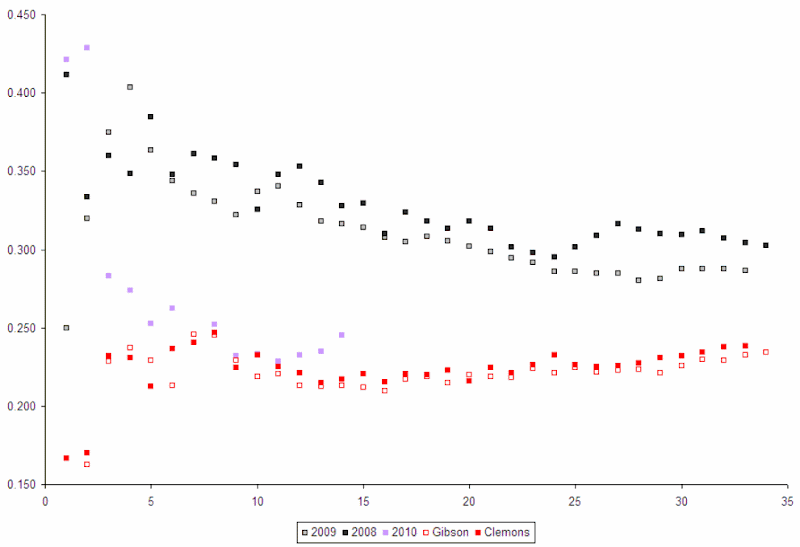
The telling stat for the home team is that he has won 13 of the 36 Rockies victories and ten of wins have come after Rockies losses.  Regardless of any stat a pitcher’s job is to put his team in the position to win.  How the pitcher gets there is some crafty pitching, some luck, and timely hitting by your side.  Baseball is a long season and time will tell whether these numbers will hold up.  I think Jimenez will probably hit a rough patch in July and August.  The team behind him is in disarray.  Scoring runs has been the Rockies Achilles heel not to mention an on and off again bullpen.  His innings pitched has raised a few eyebrows for a player with less than 100 major league starts (compared to Gibson’s 300 starts in 1968 but only 50 starts for Clemens in 1986).  And finally tracking the running average through his 14 starts of batting average on balls in play (BABIP) suggest that, through ten games Jimenez was walking with Gods, he has since then started to regress to his mean.

BABIP

Heralding a particular player at this point in the season as the greatest is a bit premature.  Although as a Rockies fan I am rooting for the franchise’s first 20-game winner!  Additionally if at this point in the season I needed one win, then Jimenez would be on the rubber.  His season so far stacks up pretty well with two of greats – Gibson and Clemens.


No Soup For Ubaldo

There probably isn’t a single baseball fan in the country who hasn’t heard Ubaldo Jimenez been called “lucky.”

For several weeks now, analysts have devoted countless hours and vast amounts of energy to debunking the theory that Jimenez is—as his 13-1 record and 1.15 ERA suggest—one of the best pitchers in the history of the game. And with good reason.

There’s no question Jimenez is a talented pitcher entering the prime of what will certainly be an impressive career. But he’s not an all-time great, and he’s certainly not the greatest of all time.

Jimenez’ 7.8 K/9 rate is impressive (though not legendary—he’s looking up at not only Tim Lincecum and Josh Johnson, but guys like Javier Vazquez and Felipe Paulino), but it’s not enough for us to turn a blind eye to his wildness (3.2 BB/9). A 2.44 K/BB ratio is nothing to sneeze at, but it’s nothing compared to Dan Haren (5.05), Roy Halladay (5.63), or the superhuman Cliff Lee (16.75).

As a result, Ubaldo’s FIP is a more mortal-looking 2.93. That’s nothing to sneeze at, and it’s the seventh-best mark in the game. But it’s more than two-and-a-half times his ridiculous 1.15 ERA.

And that’s before you consider Jimenez’ ludicrously low 3.8% HR/FB rate. That’s why his 3.61 xFIP is significantly higher even than his FIP—and that’s normalized for a pitcher in a neutral park, not one who plays half his games at the launching pad that is Coors Field. Substitute his xFIP for his ERA and ignore the wins (naturally, he wouldn’t have as many if he gave up more runs) and you’ve got a questionable All-Star, not a unanimous Cy Young.

So where is all this luck coming from?

The fishiest thing about Jimenez’s season so far is his 91.2% LOB rate. In other words, fewer than one out every 11 baserunners he’s allowed have ended up crossing the plate. The discrepancy between his strand rate and the norm (72 percent) is greater than the overall range of qualified pitchers’ LOB rates in 2008.

It makes sense that a better pitcher would strand more runners; the better the pitcher, the better the chance of making an out, so there is less opportunity for the other team to score. But Jimenez’ 91.2% figure places his performance well outside the reach of logic and fully inside the realm of luck.

Consider the case of John Candelaria, whose 88.8% strand rate in 1977 stands as the closest anyone has come to pulling a Ubaldo over a full season since at least 1974. The year before that, his strand rate was 72.5%; the year after, it fell to 76.8%. Simply put, you can’t sustain a number like that unless you’re playing Xbox.

Then, of course, there is the issue of Jimenez’. BABIP. I’m a firm believer that pitchers have some degree of control over where and how hard the ball is hit. I wouldn’t think it noteworthy if Ubaldo’s hit rate had merely slipped to .290, or .280, maybe even .270. But if you think the ability to induce weak contact is the reason his hit rate stands at an historically low .239 mark, I’m going to have to stop you right there.

It takes a lot more than talent for a pitcher to sustain a hit rate that low for more than a few weeks. Since 1989, only one pitcher has posted a hit rate at or below Jimenez’ current .239 mark over a full season without it ballooning 50 points or more the following year.

Now, some say that Jimenez’ hit rate is explained by the kind of contact he’s induced—his 13.8% line-drive rate is the third-lowest in the league, and his 54.9% groundball rate ranks fifth. But there’s no refuge in that argument, either.

Looking at tRA, which (unlike FIP) takes his batted-ball profile into account, Jimenez is expected to give up 3.09 runs per nine innings. That’s not a bad number by any stretch, but it’s not good enough to put Ubaldo in the history books. So even if you assume that his low line drive and HR/FB rates are the product of sustainable skill and not felicitous chance, Jimenez could be expected to give up nearly three times as many runs if he had neutral luck.

There’s no question Ubaldo Jimenez is a good pitcher, or that his is an arm to watch for years to come. But once the winds of fortune stop blowing in from the Coors bleachers, no one will mistake him for the best pitcher in the game.

Lewie Pollis lives outside of Cleveland, Ohio, and will be starting at Brown University in Fall 2010. Like at least half the people who will read this article, his dream is to be GM of a baseball team. For more of Lewie’s writing, click here.


Burnett’s New Strategy a Cause for Concern?

Note: I originally posted this on my blog before his most recent start, but I was hoping I could perhaps get some feedback.

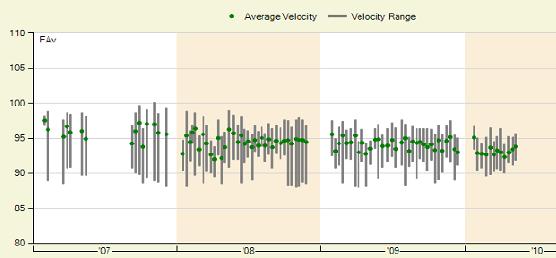
Lost amid much of the early-season trials and tribulations of this year’s Yankees squad has been the performance of the Yanks’ lead pie-thrower, A.J. Burnett. While Burnett can boast of an improvement in his walk rate (3.11 BB/9 in 2010; 4.22 in 2009; 3.75 career), his strike-out rate has seen a steeper drop (2010 K/9: 6.43; 2009: 8.48; 8.27 career). David Golebiewski of FanGraphs recently wrote an article in which he pointed out that hitters are making much more contact this year than in past years off of Burnett. Golebiewski posited that this was due to the ineffectiveness of Burnett’s knuckle-curve, but I believe that Burnett’s diminished fastball velocity and overall approach to pitching has also played a role in making him more hittable. Here are Burnett’s velocity charts:

In 2007, the first year in which velocity data was available from Pitch F/x, Burnett was averaging 95.9 MPH (the gap you see in the velocity chart can be explained by a two month-long stay on the disabled list for a shoulder strain). In 2008, Burnett’s velocity saw a rather large drop to 94.4. The velocity held steady in ’09, when he averaged 94.2 on the fastball. This year, however, Burnett’s velocity has dropped down to 93.2.

There are two possible explanations for Burnett’s decrease in velocity. It is very possible that Burnett is toning down his velocity in order to have better command, and the decreased walk rate appears to indicate that. The decrease in overall fastball velocity could also do with the fact that Burnett has added a two-seam fastball to his repertoire, throwing it 25.1% of the time, in comparison to his four-seamer, which he throws 46.8% of the time. As a side note, the four-seamer and the two-seamer have similar velocities (4-seam: 93.3; 2-seam: 93.1).

Apparently, Burnett has adjusted his pitching philosophy. He has spoken of his wishes to “become more of a pitcher” (Mark Feinsand) and to “pitch to contact” (Chad Jennings). Developing the sinker seems to go along with that thought process. Catcher Chad Moeller, as quoted in the Jennings piece, indicated that the two-seamer away to left-handed hitters was intended to induce more groundballs. Indeed, it has. In 2010, Burnett has posted his highest ground-ball rate against lefties (51.1%) since 2007, when it eclipsed 53%. Overall, Burnett is inducing ground balls at a rate of 48.4%, which is good, but not great.

Usually, it’s good to have a third pitch, especially if you are a starting pitcher. I laud the fact that Burnett has started using a two-seam fastball and is trying to be smarter about pitching, but the overall approach that he has adopted this year has robbed him of his gargantuan K rate. The meager improvements in walk rate and ground-ball rate are not enough to justify losing nearly 2 K/9 innings. Keeping balls on the ground is great and all, but the strength of Burnett’s game has always been inducing swings and misses. Getting away from his bread and butter does not appear to be working.